
“The isolation of the artist makes it difficult to produce a really grown-together work of art, where painting, sculpture, and architecture exist as a unit.... Only at the Bauhaus did we achieve this working together.” — Walter Gropius
“A vital architectural spirit, rooted in the entire life of a people, represents the interrelation of all phases of creative effort, all arts, all techniques,” Walter Gropius wrote in his essay “The Theory and Organization of the Bauhaus” in 1923. Gropius was a central figure in the rise of the Modern Movement in the early 1900s, an architectural movement that broke with ornamentation in favor of a style and methodology informed by the look and function of machines. The movement would become known in the 1930s as the International Style. A founder and leader of the Bauhaus, a German school of art and design, Gropius was also a prolific architect whose work, ranging from factories to apartment complexes, made an indelible impact on modern architecture. Born in Berlin in 1883, Gropius began studying architecture in 1903 at the Technische Hochschule in Munich, but abandoned his studies after five semesters. He soon joined the office of German architect Peter Behrens, where he was employed as an assistant and building supervisor. Behrens was one of the period’s leading German architects. His interest in the relationship between artistry and mass production informed Gropius’s fascination with industrial architecture and serial production—evident in his design of the Fagus shoe last factory, his first major commission, designed with Adolf Meyer in 1911. In his 1913 article “The Development of Modern Industrial Architecture,” Gropius became one of the first European architects to write about American industrial buildings. His essay, illustrated by images of factories and grain silos, encouraged architects to adopt “exactly expressed form, free of all accidental effects, clear contrasts, orderly articulation in the arrangement of every part, and unity of form and color.” Gropius’ article was enormously influential; in the coming years, architects including Le Corbusier and Erich Mendelsohn republished images from his text while also calling for a new movement in architecture that rejected ornament in favor of forms and materials inspired by the shape and function of machines. After World War I, Gropius founded the Bauhaus in 1919 in Weimar (the school would move to Dessau and then Berlin due to mounting political pressure). Gropius’s design of the Bauhaus building in Dessau—explicitly inspired by factory architecture—became an architectural emblem of the school’s radical pedagogy. It brought together artists, architects, and designers around an experimental curriculum focused on the role of modern art and design in society. In Gropius’s words, the school was “a reunion between creative arts and the industrial world.” Artists and designers like Oskar Schlemmer, Paul Klee, Herbert Bayer, and Vasily Kandinsky, among many others, joined the Bauhaus faculty. The school also taught typography, weaving, and industrial design, and produced some of the era’s most groundbreaking artists and designers, such as Marianne Brandt, Anni Albers, and Marcel Breuer, all of whom also went on to teach at the school. The Nazis shut down the Bauhaus in 1933, prompting many of its members to flee abroad. In 1937 Gropius settled in the United States, becoming a professor at Harvard University. He was able to bring many other Bauhaus members with him, enabling the school’s ideology to spread to the US. Gropius built his family’s home in Lincoln, Massachusetts. It was constructed with all of the central components of modern architecture, such as strip windows and a flat roof— structural elements informed by factory architecture. Afterwards, he received many commissions for private homes, and after World War II formed the architectural office TAC (The Architects’ Collaborative), whose most notable commissions included the Pan Am building in Manhattan and the Rosenthal Porcelain Factory in Amberg, Germany. While none of TAC’s projects attained the same status as Gropius’s earlier work in Germany, he continued to cement his status as an internationally celebrated leader of the modern movement.
Note: Opening quote is from Gropius, Walter, and JONATHAN BARNETT. “An Unpublished Interview with Walter Gropius, December 1960.” Journal of the Society of Architectural Historians 77, no. 4 (2018): 407. https://www.jstor.org/stable/26771362.
Mallory Cohen, Curatorial Assistant, Department of Architecture and Design, 2023
Works in Collection
1 works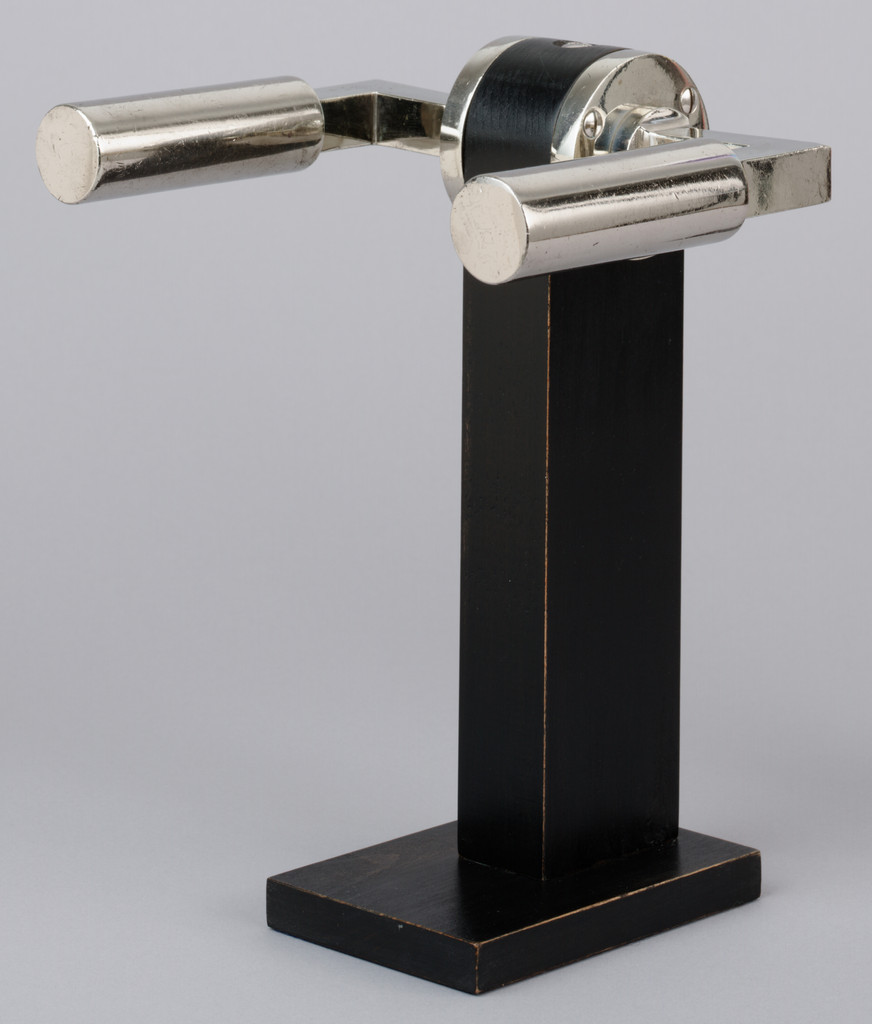
Exhibitions
24 exhibitionsFeb 09, 1932 – Mar 23, 1932
Modern Architecture: International Exhibition
67 artists · 1 curator
Nov 19, 1934 – Jan 20, 1935
Modern Works of Art: 5th Anniversary Exhibition
117 artists
Mar 02, 1936 – Apr 19, 1936
Cubism and Abstract Art
113 artists · 1 curator
Jun 08, 1936 – Sep 02, 1936
Modern Exposition Architecture
26 artists · 1 curator
Feb 10, 1937 – Mar 07, 1937
Modern Architecture in England
41 artists · 1 curator
Jun 28, 1938 – Sep 12, 1938
Wheaton College Competition
27 artists · 1 curator
Dec 07, 1938 – Jan 30, 1939
Bauhaus: 19191928
66 artists
Feb 15, 1939 – Mar 15, 1939
Three Centuries of American Architecture
54 artists · 2 curators
Jan 12, 1940 – Mar 03, 1940
Smithsonian Competition
18 artists · 1 curator
Sep 09, 1941 – Sep 30, 1941
The Wooden House in America
10 artists
May 24, 1944 – Oct 22, 1944
Built in the U.S.A., 193244
58 artists · 1 curator
Jan 16, 1945 – Mar 04, 1945
The Lesson of War Housing
9 artists
Aug 29, 1945 – Sep 23, 1945
Textile Design
32 artists · 1 curator
Jan 08, 1946 – Jan 30, 1946
If You Want to Build a House
17 artists · 1 curator
Jun 24, 1947 – Sep 21, 1947
Two Cities: Planning in North and South America
5 artists · 1 curator
Aug 03, 1949 – Oct 02, 1949
Painting and Sculpture in Architecture
51 artists
Oct 05, 1949 – Dec 04, 1949
Modern Art in Your Life
164 artists · 1 curator
Jul 11, 1950 – Sep 05, 1950
Three Modern Styles
94 artists
Dec 16, 1952 – Feb 15, 1953
De Stijl
38 artists · 2 curators
Jan 20, 1953 – Mar 15, 1953
Built in USA: Post-War Architecture
34 artists · 1 curator
Mar 23, 1954 – May 02, 1954
Signs in the Street
9 artists · 2 curators
Dec 17, 1958 – Feb 23, 1959
20th Century Design from the Museum Collection
257 artists · 2 curators
Nov 14, 1979 – Jan 22, 1980
Art of the Twenties
167 artists · 1 curator
Jul 22, 1981 – Sep 15, 1981
Marcel Breuer: Furniture and Interiors
6 artists · 2 curators