
“I cannot now change my style, which I acquired, as you can imagine, by dint of stubborn labor.” — Henri Rousseau
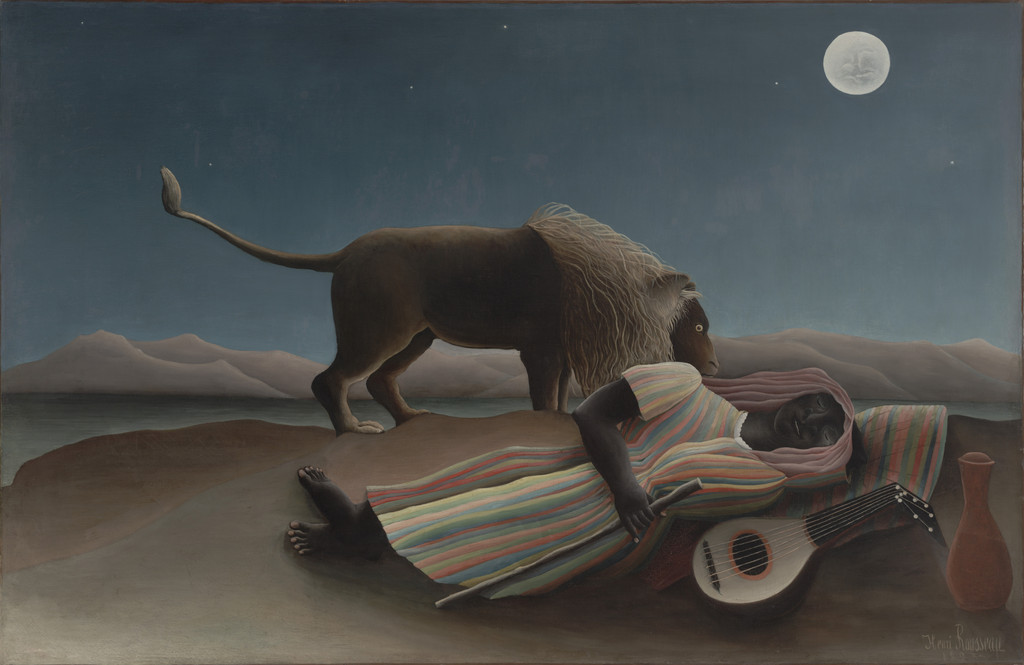
“Long live Rousseau!” These words appeared on a banner decorating a party held in Paris in November 1908. The guest of honor was Henri Rousseau, a self-taught painter who had captured the imagination of a younger generation of artists and writers in the French capital. One of these artists was Pablo Picasso, who hosted the party in his studio with the help of his partner, the artist and model Fernande Olivier. Gathered around a makeshift table were dozens of guests, among them the poet Guillaume Apollinaire, the sculptor Constantin Brâncuși, the painters Georges Braque and Marie Laurencin, and the writer Gertrude Stein. Following hours of food, drink, speeches, songs, and toasts, the 64-year-old Rousseau turned to thank his much younger host. “We are the two greatest painters of the era,” Rousseau purportedly said to Picasso, “you in the ‘Egyptian’ genre, I in the modern genre.” By “Egyptian,” Rousseau appears to have been referencing the flattened planes and jutting forms of Picasso’s most recent paintings, inspired in part by African and Iberian masks. And by “modern,” he may have been alluding to the up-to-the-minute objects found in many of his own paintings of French cities and towns: paved roads, iron bridges, factory chimneys, even aircraft such as balloons and planes. Rousseau had begun to paint seriously in middle age, after working for decades in a customs office in the outskirts of Paris. (This was the origin of his nickname, “le Douanier,” or “the Customs Officer.”) From the start, the artist understood his aim to be the truthful representation of modern life. “He continued to improve his mastery,” wrote Rousseau in 1895, referring to himself in the third person, “and is now on the way to becoming one of our best realist painters.” Yet Rousseau’s self-described “realism” was unlike that of his French predecessors. Rather than searing portrayals of rural and urban poverty, the artist’s paintings depicted tidy suburbs and prim families with vivid colors, simple shapes, uniform lighting, and crisp brushwork that both his supporters and detractors described as childlike. “Mention must be made of Monsieur Henri Rousseau, whose determined naiveté manages to become a style,” wrote the critic Thadée Natanson in 1897, with hints of admiration and mockery. This “style,” he continued, was characterized by “ingenuous and stubborn simplicity.” Moreover, Rousseau had embraced a new subject in the 1890s that few would consider “realist”: tropical jungles brimming with riotous combinations of flora and fauna, from palm trees and lotus flowers to flamingoes and jaguars. The artist undertook his first jungle painting in 1891, then proceeded to complete around 20 in the next two decades. The last and the largest of these jungle paintings was The Dream (1910), a nighttime scene teeming with life. Half-submerged in the lush foliage are watchful lions, preening birds, and dangling monkeys, along with other creatures. Positioned among these creatures are two figures: at right, a musician who plays the flute, and at left, a nude reclining on a couch. How to explain the incongruous appearance of household furniture in a rainforest? A curious critic posed this question to the artist in 1910, when the painting was exhibited at the Salon des Artistes Indépendants, a jury-free exhibition in Paris where Rousseau had shown his work since the mid-1880s. “This woman asleep on the couch is dreaming she has been transported into the forest,” the artist replied, “listening to the sounds from the instrument of the enchanter.” Rousseau, though he often claimed otherwise, never set foot in a tropical jungle. To paint The Dream, he relied on images from magazines, novels, and postcards, as well as his own sketches of the Jardin des Plantes—a botanical garden and zoo in Paris—and of two World Fairs held in the city, one in 1889 and another in 1900. “As a painter of the ‘exotic,’” the scholar Christopher Green has observed, “Rousseau offered, in the end, Parisian jungles.” Though homegrown, these “Parisian jungles” were shaped by French colonialism. Rousseau’s sources—from illustrated magazines to the World Fairs—sought to present France as a major colonial power. And paintings like The Dream project fears and fantasies onto distant landscapes and faraway peoples. In this way, too, the artist was decidedly modern. The Sleeping Gypsy, painted by Rousseau in 1897, may be as enigmatic as The Dream. Lying flush with the picture plane is a soundly sleeping figure in a striped dress; a lion prowls nearby. Referred to by the artist as a “bohémienne” (“Gypsy”), the sleeping figure and her desert surroundings reflect Rousseau’s interest in northern Africa. (In 19th-century France, many believed that the Romani people had originated in Egypt.) But The Sleeping Gypsy is far from an ethnographic study. Instead, it is as though the artist rendered another dream. Using his supposedly child-like tools—clean lines, bright colors, lucid forms—Rousseau composed a mysterious picture, one poised between beauty and terror.
Note: opening quote is from Rousseau’s unpublished autobiography (Paris: 1895), cited in Rousseau, Henri, Roger. Shattuck, Henri. Béhar, and Michel. Hoog. Henri Rousseau Essays. New York: The Museum of Modern Art, 1985, p. 38.
Annemarie Iker, Mellon-Marron Research Consortium Fellow, 2021
Works in Collection
3 works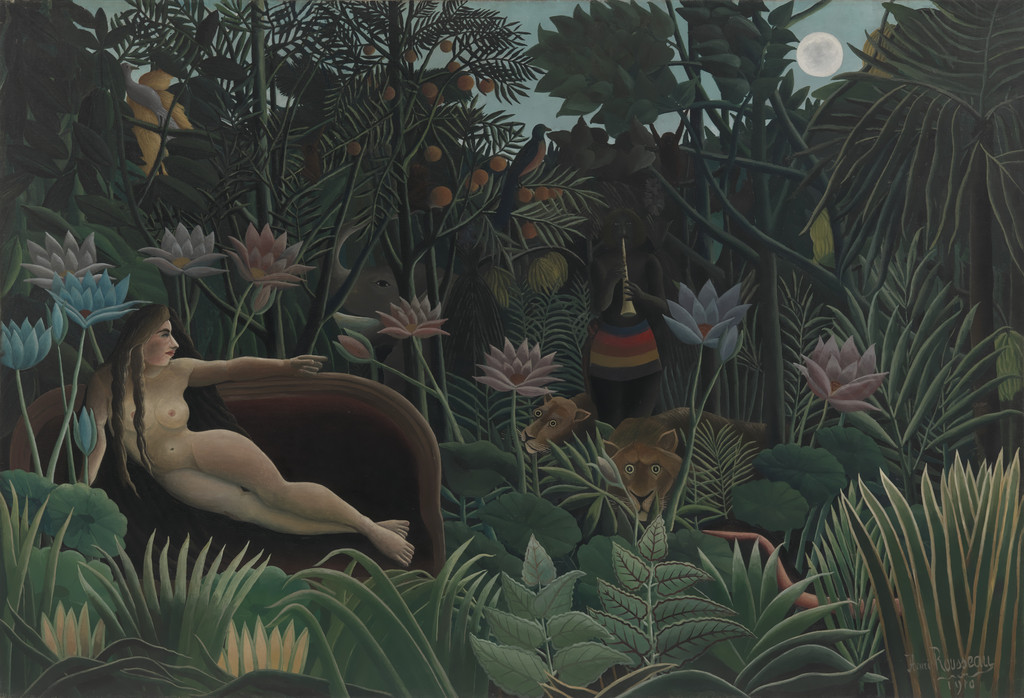
Exhibitions
49 exhibitionsMay 17, 1931 – Oct 06, 1931
Memorial Exhibition: The Collection of the Late Lillie P. Bliss
25 artists
Jul 20, 1932 – Oct 05, 1932
A Brief Survey of Modern Painting
38 artists
May 13, 1933 – May 31, 1933
Fruit and Flower Paintings
31 artists
Jul 10, 1933 – Sep 30, 1933
Summer Exhibition: Painting and Sculpture
48 artists
Oct 03, 1933 – Oct 27, 1933
Modern European Art
53 artists
May 14, 1934 – Sep 12, 1934
The Lillie P. Bliss Collection, 1934
22 artists
Nov 19, 1934 – Jan 20, 1935
Modern Works of Art: 5th Anniversary Exhibition
117 artists
Jun 04, 1935 – Sep 24, 1935
Summer Exhibition: The Museum Collection and a Private Collection on Loan
53 artists
Mar 02, 1936 – Apr 19, 1936
Cubism and Abstract Art
113 artists · 1 curator
Jul 20, 1936 – Sep 02, 1936
Summer Exhibition: The Museum Collection and a Private Collection on Loan
26 artists
Dec 07, 1936 – Jan 17, 1937
Fantastic Art, Dada, Surrealism
179 artists · 1 curator
Jun 23, 1937 – Nov 04, 1937
Summer Exhibition: Painting and Sculpture from the Museum Collection and on Loan
53 artists
Apr 27, 1938 – Jul 24, 1938
Masters of Popular Painting: Modern Primitives of Europe and America
10 artists · 3 curators
May 10, 1939 – Sep 30, 1939
Painting, Sculpture, Prints
154 artists
Jan 12, 1940 – Mar 03, 1940
Paintings and Sculpture from the Museum Collection
55 artists
Jan 26, 1940 – Mar 24, 1940
Modern Masters from European and American Collections
25 artists
Oct 23, 1940 – Jan 12, 1941
Painting and Sculpture from the Museum Collection
80 artists
May 06, 1941 – Apr 30, 1941
Painting and Sculpture from the Museum Collection
74 artists
Jul 01, 1941 – Jul 15, 1941
Animals in Art; Designing a Stage Setting
28 artists
Oct 21, 1941 – Apr 30, 1944
Modern Primitives: Artists of the People
19 artists
Mar 18, 1942 – May 03, 1942
Henri Rousseau
1 artist
Dec 09, 1942 – Jan 24, 1943
Twentieth Century Portraits
159 artists · 1 curator
May 24, 1944 – Oct 15, 1944
Painting, Sculpture, Prints
133 artists · 1 curator
Mar 06, 1945 – Mar 25, 1945
What is Modern Painting?
37 artists
Jun 20, 1945 – Feb 13, 1946
The Museum Collection of Painting and Sculpture
174 artists
Nov 28, 1945 – Feb 03, 1946
Museum of Modern Art Color Reproductions
13 artists
Feb 19, 1946 – May 05, 1946
The Museum Collection of Painting
67 artists
Jun 11, 1946 – Oct 06, 1946
Designed for Children
20 artists · 1 curator
Jul 02, 1946 – Sep 22, 1946
Paintings from New York Private Collections
37 artists · 1 curator
Jul 02, 1946 – Sep 12, 1954
Paintings, Sculpture, and Graphic Arts from the Museum Collection
112 artists · 1 curator
May 10, 1949 – Jul 10, 1949
Master Prints from the Museum Collection
132 artists · 2 curators
Aug 29, 1950 – Oct 15, 1950
Painting and Sculpture from the Museum Collection
72 artists · 1 curator
Jun 26, 1951 – Sep 09, 1951
Selections from 5 New York Private Collections
34 artists · 1 curator
Jan 29, 1952 – Mar 23, 1952
Masterworks Acquired through the Mrs. Simon Guggenheim Fund
17 artists · 1 curator
Oct 19, 1954 – Feb 06, 1955
XXVth Anniversary Exhibition: Paintings from the Museum Collection
260 artists
Dec 07, 1954 – Feb 01, 1955
Modern Masterprints of Europe
72 artists · 1 curator
Feb 25, 1955 – Apr 24, 1955
Fifteen Paintings by French Masters of the 19th Century from the Louvre and the Museums of Albi and Lyon
15 artists · 1 curator
Mar 05, 1955 – Apr 24, 1955
Painting and Sculpture from the Museum Collection: New Acquisitions
22 artists · 1 curator
May 31, 1955 – Sep 07, 1955
Paintings from Private Collections
33 artists · 1 curator
Nov 13, 1957 – Jan 05, 1958
Recent Acquisitions
37 artists
May 27, 1964
Painting and Sculpture from the Museum Collection
169 artists
Jul 01, 1971 – Sep 27, 1971
The Artist as Adversary
140 artists · 1 curator
Jan 07, 1972 – Feb 22, 1972
Naive Painting: A Selection from the Museum Collection
25 artists · 1 curator
Oct 18, 1972 – Jan 07, 1973
Philadelphia in New York: 90 Modern Works from the Philadelphia Museum of Art
41 artists · 2 curators
Dec 17, 1976 – Mar 01, 1977
European Master Paintings from Swiss Collections: Post-Impressionism to World War II
35 artists · 1 curator
Sep 26, 1977 – Nov 28, 1977
Dream/Reality/Dream
33 artists · 1 curator
Oct 25, 1980 – Jan 27, 1981
Masterpieces from the Collection: Selections from the Late Nineteenth- and Early Twentieth-Centuries
26 artists · 1 curator
Aug 18, 1981 – Oct 21, 1981
Alfred H. Barr, Jr., 19021981
3 artists
Feb 21, 1985 – Jun 04, 1985
Henri Rousseau
1 artist · 3 curators