Every face you saw up close in the first photograph is somewhere in this one, and you will never find it.
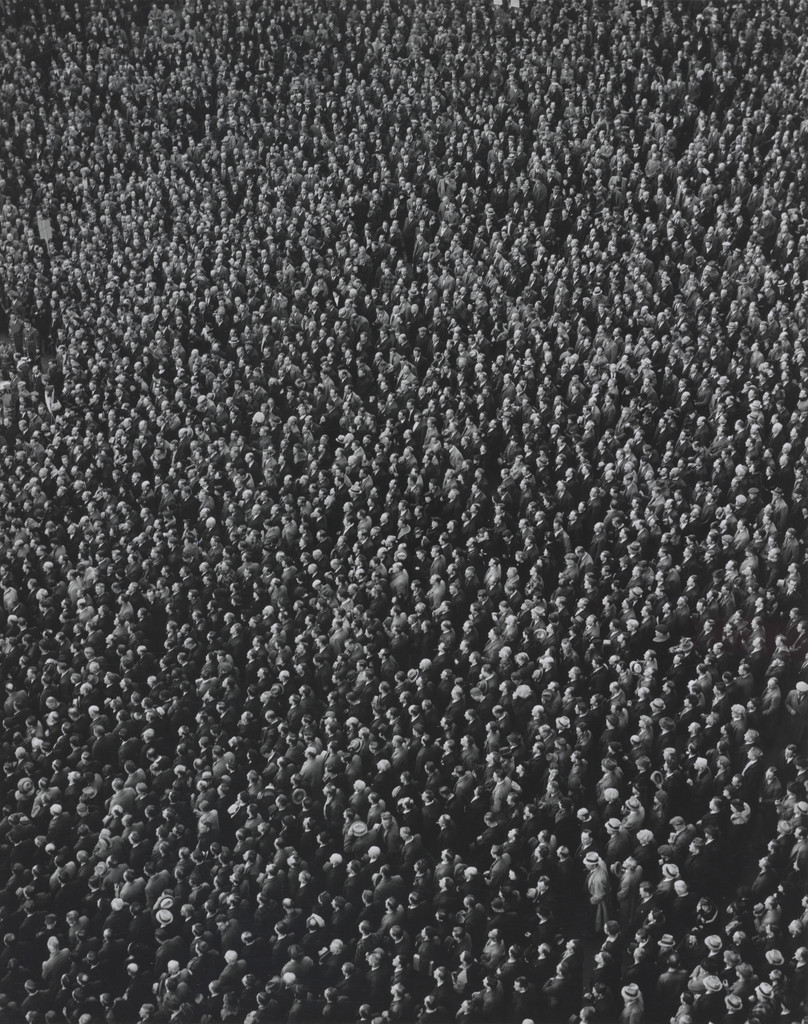
Arthur Siegel climbed something — a building, a scaffold, a crane — and pointed his camera straight down at a public gathering in 1939. What he saw through the lens was not a crowd of individuals but a texture. Thousands of fedoras and bare heads compress into a field of light and shadow, an almost musical pattern of repetition with variations. The photograph is called Right of Assembly, which gives the image a political frame, but what strikes you first is the formal beauty: the way strangers, seen from above, become rhythm.
This is the opposite knowledge from Tsuchida's bridge. Where he closed the distance until a stranger's face filled your vision, Siegel opens it until faces dissolve into dots. Both photographers are asking the same question — what does the camera know about strangers? — but from opposite ends of the telescope. Up close, the camera makes us uncomfortably aware of presence. From above, it makes us uncomfortably aware of quantity. Look long enough at this photograph and you start to feel the vertigo of your own smallness. You are one hat in a sea of hats. You are a shadow among shadows.
And yet: if you squint, if you lean close to the print, you can start to pick out individuals. A woman in a light coat. A gap where someone has turned away. The intimacy hasn't vanished — it's just been hidden inside the pattern. The camera knows this, too: that every crowd is also a collection of solitudes, and distance is just another kind of closeness.
Arthur Siegel (American, 1913–1978)
Right of Assembly, 1939
Gelatin silver print, 13⅜ × 10⅝ in.
Purchase · The Museum of Modern Art, New York
Have you ever looked down at a crowd and felt both powerful and invisible at once?
Every face you saw up close in the first photograph is somewhere in this one, and you will never find it.
Arthur Siegel climbed something — a building, a scaffold, a crane — and pointed his camera straight down at a public gathering in 1939. What he saw through the lens was not a crowd of individuals but a texture. Thousands of fedoras and bare heads compress into a field of light and shadow, an almost musical pattern of repetition with variations. The photograph is called Right of Assembly, which gives the image a political frame, but what strikes you first is the formal beauty: the way strangers, seen from above, become rhythm.
This is the opposite knowledge from Tsuchida's bridge. Where he closed the distance until a stranger's face filled your vision, Siegel opens it until faces dissolve into dots. Both photographers are asking the same question — what does the camera know about strangers? — but from opposite ends of the telescope. Up close, the camera makes us uncomfortably aware of presence. From above, it makes us uncomfortably aware of quantity. Look long enough at this photograph and you start to feel the vertigo of your own smallness. You are one hat in a sea of hats. You are a shadow among shadows.
And yet: if you squint, if you lean close to the print, you can start to pick out individuals. A woman in a light coat. A gap where someone has turned away. The intimacy hasn't vanished — it's just been hidden inside the pattern. The camera knows this, too: that every crowd is also a collection of solitudes, and distance is just another kind of closeness.