What happens when the photographer catches herself in the act?
Ilse Bing set up two mirrors and her Leica on a tripod in 1931, and for a moment she became a stranger to herself.
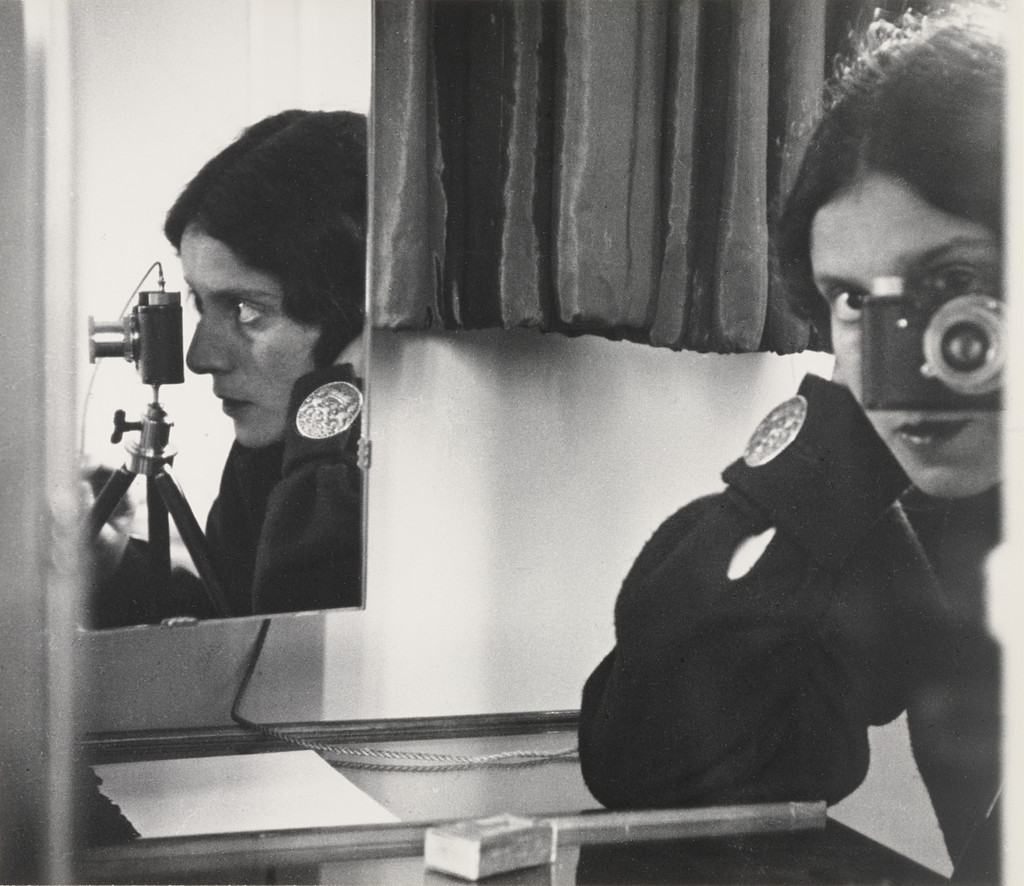
Look at how the photograph splits her in two. On the left, in profile, she's absorbed in the act of seeing — her hand on the camera, her gaze intent. On the right, reflected straight on, she stares back at you with one visible eye, half-hidden by the lens. The camera sits between these two versions of her like a hinge. She is both the watcher and the watched, the subject and the photographer, the stranger on the bridge and the one holding the shutter release.
This is the question the photograph asks: Who is the stranger when you photograph yourself? Bing called her Leica "an extension of my eyes," but here the camera becomes a wedge that splits her into multiple selves. The dark curtain hanging between the mirrors divides the frame like a stage set, as if she's performing two roles at once. And maybe she is. Maybe we all are — always split between the person who looks and the person who is seen.
The geometry is so deliberate it almost hums: the crisp edges of the mirror frames, the sharp diagonal of the tripod legs, the high-contrast blacks and whites. This is 1931 — the height of European modernism, when photographers like Bing were "breaking every rule," as she put it, to discover "what the camera could do that no brush could do." What Bing discovered here is that the camera can make you a stranger in your own image. It can show you the face you never quite see when you look in the mirror: the face that's looking back.
Think back to Tsuchida's woman on the bridge. She didn't know she was about to fill a stranger's frame. Bing does know — she engineered the whole encounter. And yet the photograph still catches something she didn't fully control: the uncanny doubleness of being both here and there, both seer and seen. The camera knows this about us. It knows we are always strangers, even — especially — to ourselves.
Ilse Bing (American, born Germany, 1899–1998)
Self-Portrait in Mirrors, 1931
Gelatin silver print, 10½ × 12 in.
Joseph G. Mayer Fund · The Museum of Modern Art, New York
Have you ever seen yourself in a photograph and thought, "Who is that?"
Ilse Bing set up two mirrors and her Leica on a tripod in 1931, and for a moment she became a stranger to herself.
Look at how the photograph splits her in two. On the left, in profile, she's absorbed in the act of seeing — her hand on the camera, her gaze intent. On the right, reflected straight on, she stares back at you with one visible eye, half-hidden by the lens. The camera sits between these two versions of her like a hinge. She is both the watcher and the watched, the subject and the photographer, the stranger on the bridge and the one holding the shutter release.
This is the question the photograph asks: Who is the stranger when you photograph yourself? Bing called her Leica "an extension of my eyes," but here the camera becomes a wedge that splits her into multiple selves. The dark curtain hanging between the mirrors divides the frame like a stage set, as if she's performing two roles at once. And maybe she is. Maybe we all are — always split between the person who looks and the person who is seen.
The geometry is so deliberate it almost hums: the crisp edges of the mirror frames, the sharp diagonal of the tripod legs, the high-contrast blacks and whites. This is 1931 — the height of European modernism, when photographers like Bing were "breaking every rule," as she put it, to discover "what the camera could do that no brush could do." What Bing discovered here is that the camera can make you a stranger in your own image. It can show you the face you never quite see when you look in the mirror: the face that's looking back.
Think back to Tsuchida's woman on the bridge. She didn't know she was about to fill a stranger's frame. Bing does know — she engineered the whole encounter. And yet the photograph still catches something she didn't fully control: the uncanny doubleness of being both here and there, both seer and seen. The camera knows this about us. It knows we are always strangers, even — especially — to ourselves.