Now watch a stranger who doesn't know she's being watched.
She has no idea you're looking at her. That's the whole point.
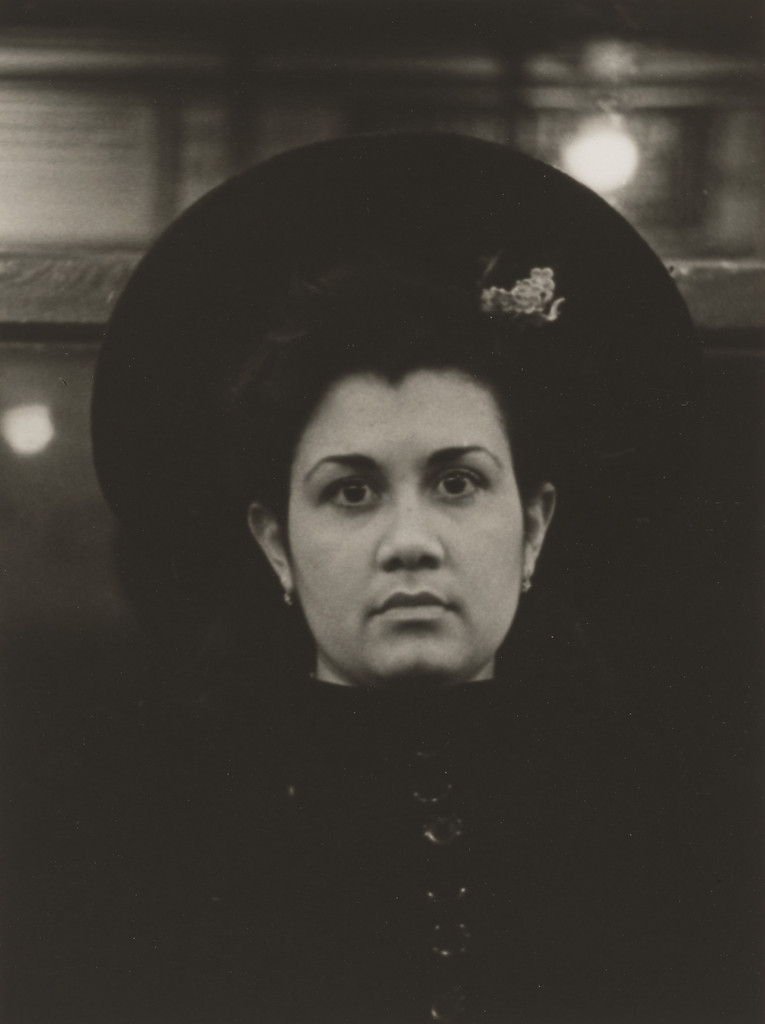
In 1938, Walker Evans took his 35mm camera onto the New York City subway and hid it under his coat. He threaded a cable release down his sleeve and spent months riding the trains, photographing passengers who had no idea they were being seen. This woman — whoever she was, on January 17, 1941 — stares straight ahead with those enormous, unguarded eyes. The dark hat frames her face like a halo or a target. Behind her, the blurred lights of the subway car glow softly. She is utterly present and utterly unaware.
This is the photograph that Tsuchida's woman on the bridge never allowed to happen. She saw the camera coming. She had time to compose her face, even if only for a split second. But Evans's subjects never got that chance. He stole these images. And that theft — that violation of the unspoken contract — is exactly what makes them so powerful. You are seeing a stranger's face in a state of total privacy, even though she's sitting in public. Her expression is unperformed. It belongs only to her inner life, until Evans took it.
Evans called his work "lyrical documentary." He insisted he wasn't making propaganda or social protest — just "pure record." But what kind of record is this? The woman's face is so close, so stark, so there that it stops being documentation and becomes something closer to portraiture. Or maybe closer to trespass. The camera knows something about her that she doesn't know it knows: what her face looks like when no one is looking. Or when she thinks no one is looking.
We've moved through four ways of seeing strangers now. Tsuchida's confrontation. Siegel's aerial dissolution. Bing's self-aware doubling. And now this: Evans's secret theft. Each one reveals a different truth about what the camera knows. But this one asks the hardest question: Is it ethical to look this closely at someone who didn't agree to be seen? Evans never asked permission. He never told his subjects. He just looked, and kept the images for decades before publishing them. The camera doesn't just know how strangers look at each other. It knows how to look at strangers without their knowledge. And once you've seen this face, you can't unsee the fact that she never knew you were looking.
Walker Evans (American, 1903–1975)
Subway Portrait, January 17, 1941
Gelatin silver print, 6¹¹⁄₁₆ × 5 in.
Purchase · The Museum of Modern Art, New York
If you found out someone had been photographing you without your knowledge, how would you feel?
She has no idea you're looking at her. That's the whole point.
In 1938, Walker Evans took his 35mm camera onto the New York City subway and hid it under his coat. He threaded a cable release down his sleeve and spent months riding the trains, photographing passengers who had no idea they were being seen. This woman — whoever she was, on January 17, 1941 — stares straight ahead with those enormous, unguarded eyes. The dark hat frames her face like a halo or a target. Behind her, the blurred lights of the subway car glow softly. She is utterly present and utterly unaware.
This is the photograph that Tsuchida's woman on the bridge never allowed to happen. She saw the camera coming. She had time to compose her face, even if only for a split second. But Evans's subjects never got that chance. He stole these images. And that theft — that violation of the unspoken contract — is exactly what makes them so powerful. You are seeing a stranger's face in a state of total privacy, even though she's sitting in public. Her expression is unperformed. It belongs only to her inner life, until Evans took it.
Evans called his work "lyrical documentary." He insisted he wasn't making propaganda or social protest — just "pure record." But what kind of record is this? The woman's face is so close, so stark, so there that it stops being documentation and becomes something closer to portraiture. Or maybe closer to trespass. The camera knows something about her that she doesn't know it knows: what her face looks like when no one is looking. Or when she thinks no one is looking.
We've moved through four ways of seeing strangers now. Tsuchida's confrontation. Siegel's aerial dissolution. Bing's self-aware doubling. And now this: Evans's secret theft. Each one reveals a different truth about what the camera knows. But this one asks the hardest question: Is it ethical to look this closely at someone who didn't agree to be seen? Evans never asked permission. He never told his subjects. He just looked, and kept the images for decades before publishing them. The camera doesn't just know how strangers look at each other. It knows how to look at strangers without their knowledge. And once you've seen this face, you can't unsee the fact that she never knew you were looking.