What if the strangers aren't people at all? What if they're stand-ins?
Lee Friedlander walked past a men's clothing store in the early 1960s and saw four strangers standing in a row. They just happened to have lightbulbs for heads.
This is what happens when you photograph a window: you get everything. The mannequins in their suits with their glowing bulb-heads and handwritten price tags ("$19.50," "$12.95"). The street reflected in the glass — ghostly, layered, half-there. The way the inside and outside collapse into a single plane so you can't quite tell what's real and what's reflection. Friedlander was a master of this kind of visual collision, the way a storefront window could turn the city into a surreal collage just by existing.
But look at those lightbulbs. They're perfect heads — glowing, smooth, featureless. They light up the suits from within, which is exactly what mannequins are supposed to do: make the clothes look alive without the inconvenience of an actual human. The strangers we've been looking at — Tsuchida's woman, Siegel's crowd, Bing's doubled self, Evans's subway passenger — they're all gone now, replaced by these blank stand-ins. And yet the mannequins work. They work so well that you almost don't notice they're headless. The camera sees them as bodies. The price tags see them as merchandise. The street reflection sees them as part of the architecture.
This is what the camera knows about strangers that we've been circling all along: we're always substituting. We see a face on a subway and we fill in a story. We see a crowd from above and we imagine lives. We see ourselves in a mirror and we split into two. And here, finally, we see suits with lightbulbs and we still read them as people — or at least as people-shaped. The mannequin is the perfect metaphor for how we look at strangers. We don't really see them. We see the outline, the costume, the price tag, the glow. We see what they're standing in for. The camera doesn't care if you're real or not. It just records the light bouncing off your surface. And maybe that's all a stranger ever is: a surface we project onto, a glowing shape in a window we pass on our way somewhere else.
Lee Friedlander (American, born 1934)
Untitled, early 1960s
Gelatin silver print, 4⅞ × 7⁵⁄₁₆ in.
Purchase · The Museum of Modern Art, New York
When you look at a stranger, how much of what you see is real, and how much is just the story you're telling yourself?
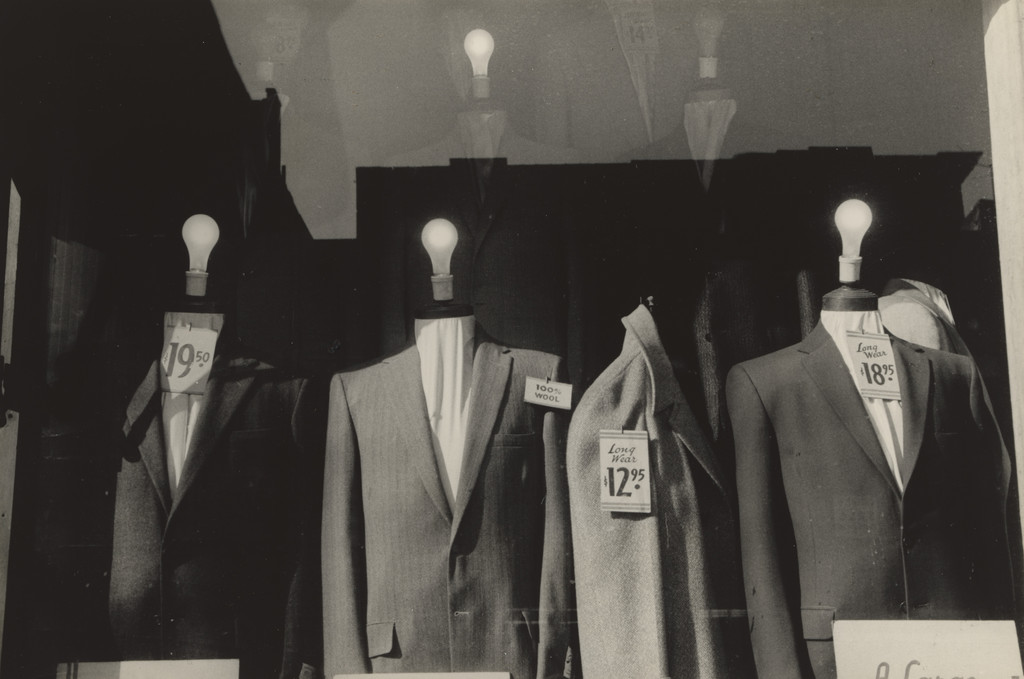
Lee Friedlander walked past a men's clothing store in the early 1960s and saw four strangers standing in a row. They just happened to have lightbulbs for heads.
This is what happens when you photograph a window: you get everything. The mannequins in their suits with their glowing bulb-heads and handwritten price tags ("$19.50," "$12.95"). The street reflected in the glass — ghostly, layered, half-there. The way the inside and outside collapse into a single plane so you can't quite tell what's real and what's reflection. Friedlander was a master of this kind of visual collision, the way a storefront window could turn the city into a surreal collage just by existing.
But look at those lightbulbs. They're perfect heads — glowing, smooth, featureless. They light up the suits from within, which is exactly what mannequins are supposed to do: make the clothes look alive without the inconvenience of an actual human. The strangers we've been looking at — Tsuchida's woman, Siegel's crowd, Bing's doubled self, Evans's subway passenger — they're all gone now, replaced by these blank stand-ins. And yet the mannequins work. They work so well that you almost don't notice they're headless. The camera sees them as bodies. The price tags see them as merchandise. The street reflection sees them as part of the architecture.
This is what the camera knows about strangers that we've been circling all along: we're always substituting. We see a face on a subway and we fill in a story. We see a crowd from above and we imagine lives. We see ourselves in a mirror and we split into two. And here, finally, we see suits with lightbulbs and we still read them as people — or at least as people-shaped. The mannequin is the perfect metaphor for how we look at strangers. We don't really see them. We see the outline, the costume, the price tag, the glow. We see what they're standing in for. The camera doesn't care if you're real or not. It just records the light bouncing off your surface. And maybe that's all a stranger ever is: a surface we project onto, a glowing shape in a window we pass on our way somewhere else.