Now look a stranger in the eye and don't look away.
His name is Ronald. You will never meet him. But for the next few moments, you have to hold his gaze.
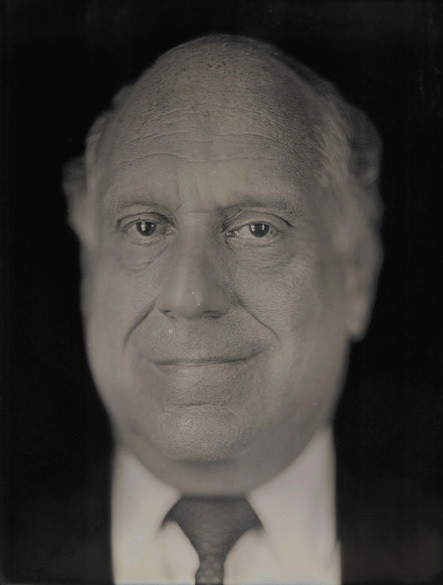
Chuck Close made this daguerreotype in 2002 — the same photographic process invented in 1839, where a silver-coated copper plate captures an image so precise it looks like a mirror frozen in time. Ronald's face fills the frame completely. There is nowhere else to look. His eyes meet yours with a calm, steady attention. The surface is so detailed you can see every pore, every line, the exact texture of his skin. The black background swallows everything except his face, which seems to hover, luminous and present, like something you could touch.
This is the opposite of Evans's subway theft. Ronald knows he's being photographed. He sat still for the exposure — daguerreotypes require long stillness — and he looked directly into the lens, which means he's looking directly at you. He agreed to this encounter. And that agreement changes everything. When you look at this photograph, you're not stealing a glance at a stranger on a train. You're accepting an invitation to stare. Ronald is offering his face to you, and the photograph holds you accountable to that offering. You can't glance away. The image won't let you.
Close spent his career making giant portraits of faces — faces so large and so close they force you to confront what it means to really see another person. He painted them, photographed them, printed them in ways that made every pore a landscape. But the daguerreotype does something the other methods don't: it makes the photograph itself a precious, singular object. This isn't a print that can be reproduced infinitely. This is the image, the one-of-a-kind surface where Ronald's face lives. When you look at it in person, you see yourself reflected in the same silver that holds his face. You become part of the image. The stranger looks at you, and you look back, and the photograph becomes a mirror that holds you both.
We've spent this whole tour learning what the camera knows about strangers. Now, at last, we're learning what we know. That it's hard to hold someone's gaze. That intimacy is built from sustained attention. That a stranger stops being a stranger the moment you agree to look — really look — and be looked at in return. Ronald isn't anonymous anymore. He's Ronald. He's here. And so are you.
Chuck Close (American, 1940–2021)
Ronald, 2002
Daguerreotype, 8¹⁄₁₆ × 6⅛ in.
Gift of the artist · The Museum of Modern Art, New York
How long can you hold eye contact with a stranger before you feel the need to look away?
His name is Ronald. You will never meet him. But for the next few moments, you have to hold his gaze.
Chuck Close made this daguerreotype in 2002 — the same photographic process invented in 1839, where a silver-coated copper plate captures an image so precise it looks like a mirror frozen in time. Ronald's face fills the frame completely. There is nowhere else to look. His eyes meet yours with a calm, steady attention. The surface is so detailed you can see every pore, every line, the exact texture of his skin. The black background swallows everything except his face, which seems to hover, luminous and present, like something you could touch.
This is the opposite of Evans's subway theft. Ronald knows he's being photographed. He sat still for the exposure — daguerreotypes require long stillness — and he looked directly into the lens, which means he's looking directly at you. He agreed to this encounter. And that agreement changes everything. When you look at this photograph, you're not stealing a glance at a stranger on a train. You're accepting an invitation to stare. Ronald is offering his face to you, and the photograph holds you accountable to that offering. You can't glance away. The image won't let you.
Close spent his career making giant portraits of faces — faces so large and so close they force you to confront what it means to really see another person. He painted them, photographed them, printed them in ways that made every pore a landscape. But the daguerreotype does something the other methods don't: it makes the photograph itself a precious, singular object. This isn't a print that can be reproduced infinitely. This is the image, the one-of-a-kind surface where Ronald's face lives. When you look at it in person, you see yourself reflected in the same silver that holds his face. You become part of the image. The stranger looks at you, and you look back, and the photograph becomes a mirror that holds you both.
We've spent this whole tour learning what the camera knows about strangers. Now, at last, we're learning what we know. That it's hard to hold someone's gaze. That intimacy is built from sustained attention. That a stranger stops being a stranger the moment you agree to look — really look — and be looked at in return. Ronald isn't anonymous anymore. He's Ronald. He's here. And so are you.