And what about when strangers stop being strangers?
Somewhere in Paris, around 1936, two people kissed on a fairground swing while Brassaï stood below and photographed them against the sky.
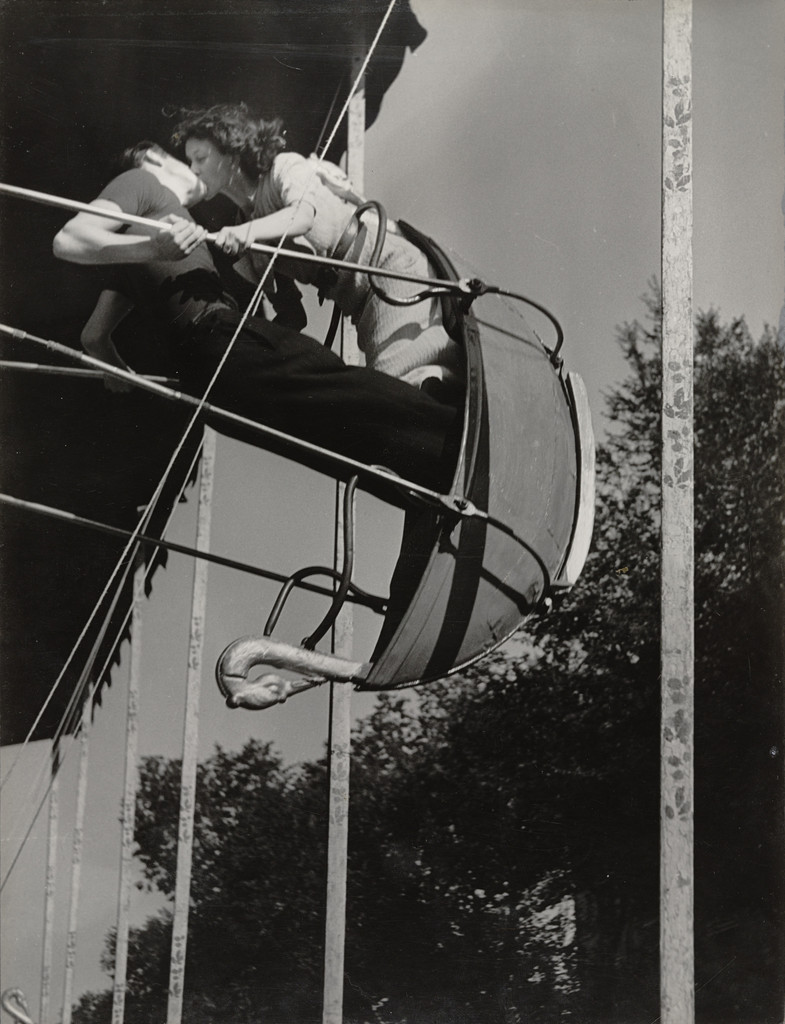
Look at how the metal frame of the swing cuts through the image — those strong diagonals, the cables pulling taut, the whole structure tilted as if the world itself has tilted with the momentum of the ride. And there, at the top of the gondola, suspended between earth and sky, two figures lean into each other. Their faces are pressed together. They are kissing. They don't know Brassaï is watching. Or maybe they do and they don't care. The kiss makes them private even though they're swinging through public space, visible to everyone at the street fair.
This is what the camera knows that we've been circling the whole tour: intimacy isn't about being alone. It's about forgetting you're being watched. Tsuchida's woman on the bridge was a stranger because she was absorbed in her own journey. Evans's subway passenger was a stranger because she thought she was invisible. Ronald became someone you could know because he agreed to be seen. But these two people on the swing? They've found a different kind of privacy — the kind that comes from being so absorbed in each other that the rest of the world falls away. The camera catches them mid-flight, mid-kiss, mid-forgetting. They are strangers to Brassaï and strangers to us, but they are not strangers to each other. And the photograph holds that transformation: the moment two separate people become a single suspended shape against the sky.
The camera doesn't just record how strangers look at each other. It records the instant they stop being strangers. The instant when all that looking — the confrontation, the distance, the surveillance, the reflection, the substitution, the sustained gaze — finally resolves into this: two people who have closed the distance completely. Who are touching. Who are, for this brief swinging moment in the air, known to each other in a way they will never be known by the camera. Brassaï can photograph the kiss, but he can't photograph what it feels like to be inside it. That's the last thing the camera doesn't know.
Brassaï (Gyula Halász) (French, born Brassó, 1899–1984)
Kiss on a Swing at a Street Fair, c. 1936
Gelatin silver print, 11½ × 8¹³⁄₁₆ in.
Anonymous gift · The Museum of Modern Art, New York
When was the last time you felt so absorbed in a moment with someone that you forgot anyone else was watching?
Somewhere in Paris, around 1936, two people kissed on a fairground swing while Brassaï stood below and photographed them against the sky.
Look at how the metal frame of the swing cuts through the image — those strong diagonals, the cables pulling taut, the whole structure tilted as if the world itself has tilted with the momentum of the ride. And there, at the top of the gondola, suspended between earth and sky, two figures lean into each other. Their faces are pressed together. They are kissing. They don't know Brassaï is watching. Or maybe they do and they don't care. The kiss makes them private even though they're swinging through public space, visible to everyone at the street fair.
This is what the camera knows that we've been circling the whole tour: intimacy isn't about being alone. It's about forgetting you're being watched. Tsuchida's woman on the bridge was a stranger because she was absorbed in her own journey. Evans's subway passenger was a stranger because she thought she was invisible. Ronald became someone you could know because he agreed to be seen. But these two people on the swing? They've found a different kind of privacy — the kind that comes from being so absorbed in each other that the rest of the world falls away. The camera catches them mid-flight, mid-kiss, mid-forgetting. They are strangers to Brassaï and strangers to us, but they are not strangers to each other. And the photograph holds that transformation: the moment two separate people become a single suspended shape against the sky.
The camera doesn't just record how strangers look at each other. It records the instant they stop being strangers. The instant when all that looking — the confrontation, the distance, the surveillance, the reflection, the substitution, the sustained gaze — finally resolves into this: two people who have closed the distance completely. Who are touching. Who are, for this brief swinging moment in the air, known to each other in a way they will never be known by the camera. Brassaï can photograph the kiss, but he can't photograph what it feels like to be inside it. That's the last thing the camera doesn't know.