And then you walk away, and you are a stranger again.
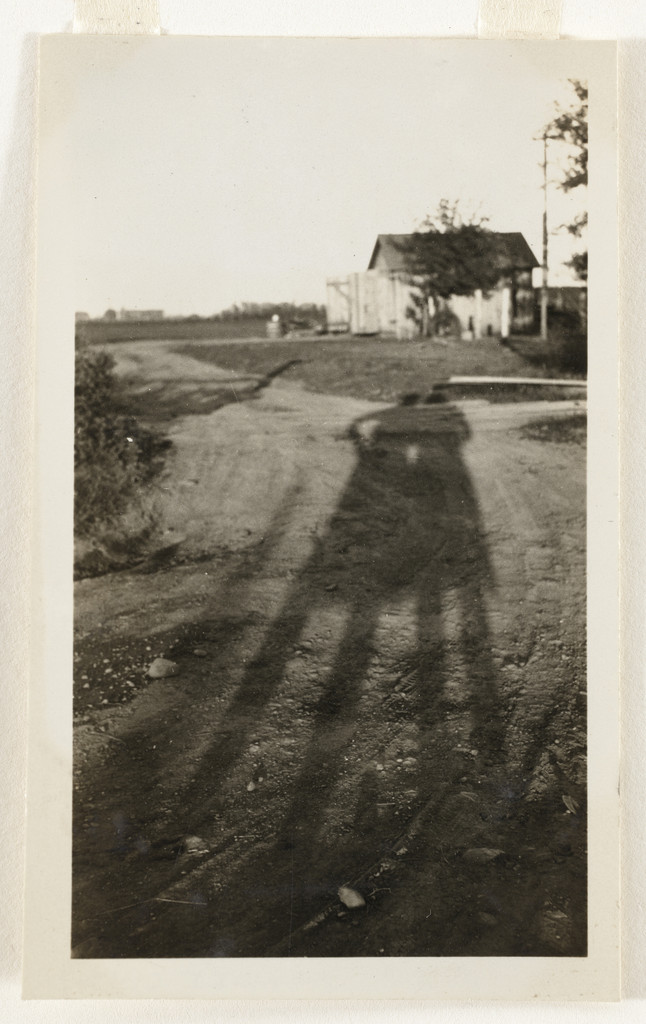
Someone stood on a dirt road, lifted a camera, and photographed their own shadow walking toward a house.
We don't know who they were. We don't know when this was made, though the print is old and the road looks like it might be anywhere in rural America in the early twentieth century. We don't know what they were thinking or where they were going. All we have is this: a long, dark shape stretched across rutted earth, a figure reduced to its silhouette, walking toward a distant farmhouse under an afternoon sun. The photographer is invisible except as shadow. They are there and not there. Present and absent. Known and unknown.
This is where the tour ends, but it's also where it began. Remember Tsuchida's woman on the bridge? She was walking toward the camera, about to become overwhelmingly close. This photographer is walking away, becoming smaller, more distant, dissolving back into the landscape. Both images are about the same thing: the distance between the person behind the camera and the person in front of it. Except here, they're the same person. The photographer has become their own stranger. They've turned the camera on themselves and found only a shadow — the most basic, the most ancient form of a likeness. A shape that proves you were there, even if it can't show your face.
We've traveled through eight ways the camera knows how strangers look at each other. Confrontation. Distance. Reflection. Theft. Substitution. Sustained gaze. The moment intimacy dissolves the category of stranger altogether. And now, finally, this: the understanding that you are also a stranger. That when you hold a camera, you become both the watcher and the watched. You cast a shadow. You leave a trace. You walk down a road toward a house you may or may not reach, and all that remains is this small, fading print — evidence that you were here, that you looked, that you tried to see and be seen.
The camera knows this about strangers: we are all walking down roads, casting shadows, trying to close distances that can never fully close. And the camera — patient, mechanical, indifferent — records it all. The approach and the departure. The closeness and the gap. The moment we see each other and the moment we walk away. Every photograph is a shadow. Every shadow is a goodbye.
Unidentified photographer
Untitled, n.d.
Gelatin silver print, 3⅞ × 2⁵⁄₁₆ in.
Gift of Jeffrey Fraenkel · The Museum of Modern Art, New York
Thank you for walking through this tour.
You are no longer a stranger here.
Someone stood on a dirt road, lifted a camera, and photographed their own shadow walking toward a house.
We don't know who they were. We don't know when this was made, though the print is old and the road looks like it might be anywhere in rural America in the early twentieth century. We don't know what they were thinking or where they were going. All we have is this: a long, dark shape stretched across rutted earth, a figure reduced to its silhouette, walking toward a distant farmhouse under an afternoon sun. The photographer is invisible except as shadow. They are there and not there. Present and absent. Known and unknown.
This is where the tour ends, but it's also where it began. Remember Tsuchida's woman on the bridge? She was walking toward the camera, about to become overwhelmingly close. This photographer is walking away, becoming smaller, more distant, dissolving back into the landscape. Both images are about the same thing: the distance between the person behind the camera and the person in front of it. Except here, they're the same person. The photographer has become their own stranger. They've turned the camera on themselves and found only a shadow — the most basic, the most ancient form of a likeness. A shape that proves you were there, even if it can't show your face.
We've traveled through eight ways the camera knows how strangers look at each other. Confrontation. Distance. Reflection. Theft. Substitution. Sustained gaze. The moment intimacy dissolves the category of stranger altogether. And now, finally, this: the understanding that you are also a stranger. That when you hold a camera, you become both the watcher and the watched. You cast a shadow. You leave a trace. You walk down a road toward a house you may or may not reach, and all that remains is this small, fading print — evidence that you were here, that you looked, that you tried to see and be seen.
The camera knows this about strangers: we are all walking down roads, casting shadows, trying to close distances that can never fully close. And the camera — patient, mechanical, indifferent — records it all. The approach and the departure. The closeness and the gap. The moment we see each other and the moment we walk away. Every photograph is a shadow. Every shadow is a goodbye.