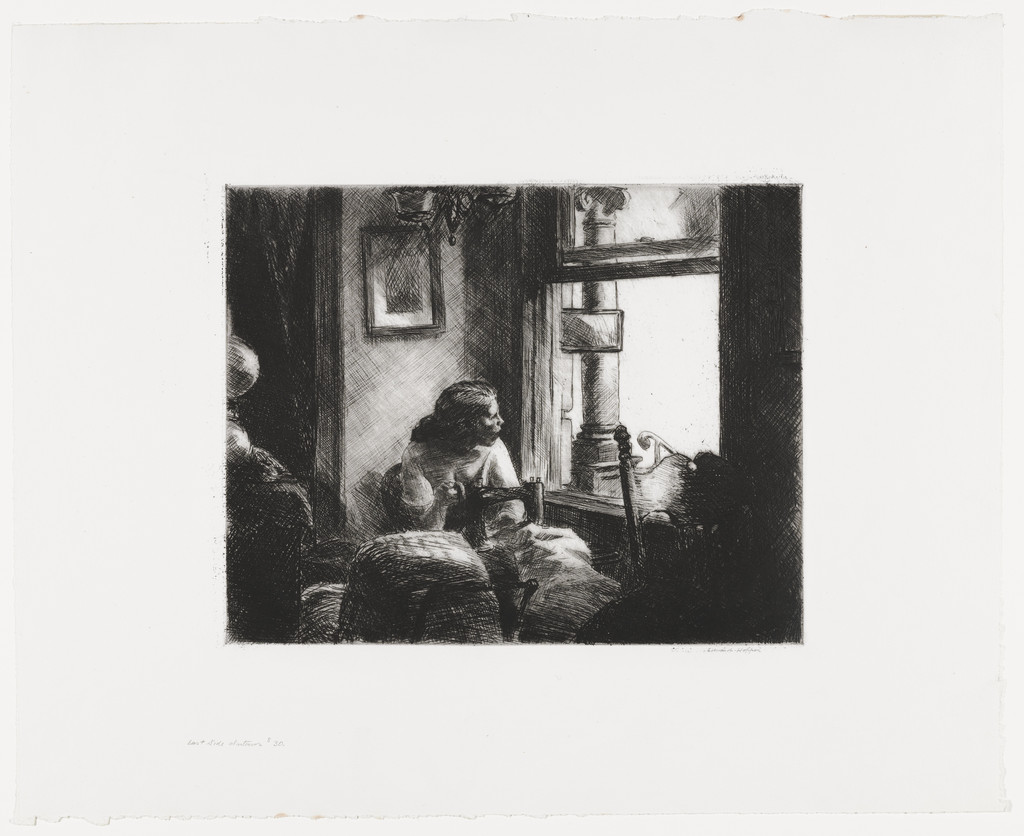
A woman sits by a window in a room she has probably sat in a thousand times before. She's sewing — or she was sewing, and has stopped. Her hands are in her lap. The light comes in hard from the left, raking across her and the floor and the rumpled bed behind her, and she is doing the thing people do when they think no one is watching: she is simply being somewhere, alone, without performing it.
Hopper made this in 1922, when he was still primarily a printmaker, still years from the oil paintings that would make him famous. Etching suited him. The medium is all about what you withhold — you cut lines into a plate, and every mark you don't make stays as blank, unreadable space. Look at the wall behind her. It's almost nothing. A few scratches of cross-hatching and then just the white of the paper, which somehow reads as solid plaster holding afternoon light. He understood that emptiness doesn't need to be filled in to feel heavy.
You are looking at her. She is looking out. The window she faces is barely indicated — a bright rectangle, a few vertical mullions — but it organizes everything. The room exists because of that window. She exists because of that window. Whatever is on the other side of it, we don't get to see. We only get her posture, which is the posture of someone watching the street from a second-floor walkup, watching without expectation, the way you watch rain.
This is where we start: with something small and legible. One room, one person, one source of light. The loneliness here isn't dramatic. No one is weeping. No one is reaching for a phone that won't ring. It's the ordinary kind — the kind that lives in the hour between lunch and evening, when the apartment is quiet and the body is still and the mind goes wherever it goes.
What is she looking at — and does it matter that we'll never know?