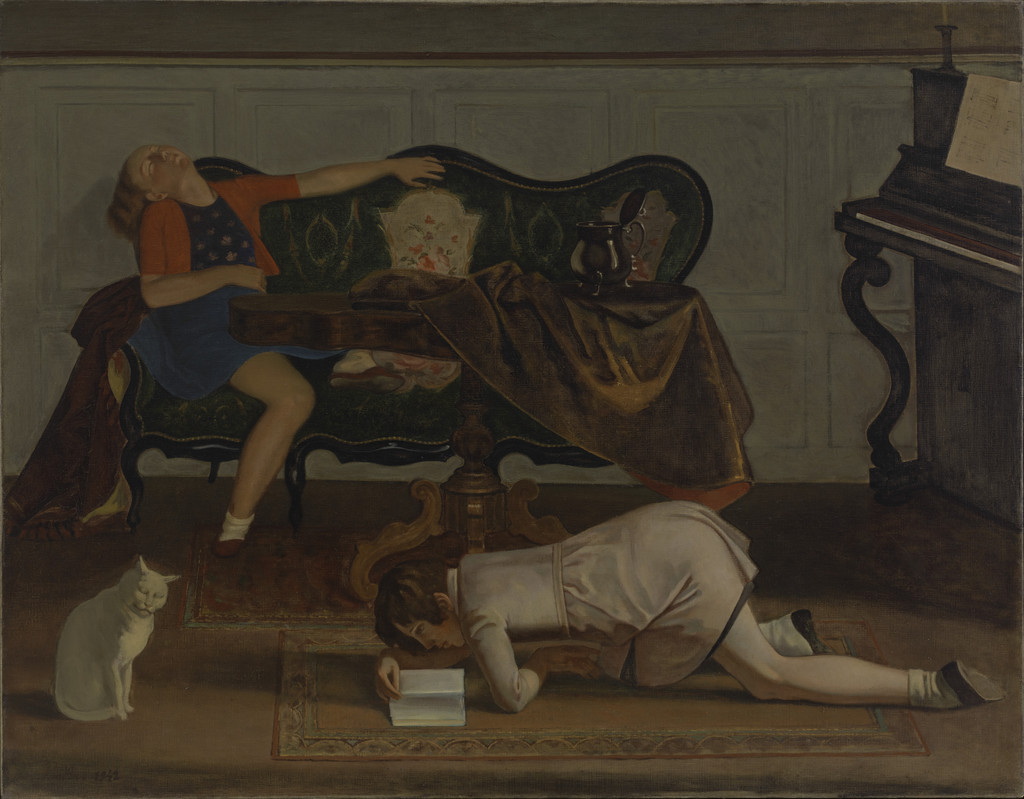
There are two people in this room. Look how far apart they are.
Not in feet — the room isn't large. But the girl sprawled on the low bench has given herself over entirely to something private. Her body is loose, abandoned to its own weight, one leg drawn up, her attention sunk inward or maybe nowhere at all. And the other figure, kneeling at the fireplace, exists in a separate atmosphere. They share walls, floorboards, the same thick afternoon light. They do not share a world.
Balthus painted this over two years, 1941 to 1943, in occupied France. He never painted quickly. That slowness matters here because everything in this room feels held — held still, held too long, the way a breath held past comfort becomes something else. The cat on the floor is the most alert creature in the painting. It watches with the frank, unbothered attention that cats have and humans in this room have lost. The muted palette — ochres, dull greens, the chalky white of skin — doesn't warm the space. It drains it. This is daylight that forgot to be cheerful.
What unsettles isn't anything dramatic. No one is crying. No one is leaving. The wrongness is structural: this is a living room where no one is living together. The furniture is solid. The walls are close. And still, each figure is sealed inside a private trance. You know this feeling if you've ever sat in a room with someone you love and realized, with a slow chill, that you couldn't reach them. That the distance between your body and theirs was not three feet of air but something unmeasurable.
Balthus understood that the most disturbing loneliness doesn't happen in empty rooms. It happens in occupied ones.
Have you ever been in a room with someone and felt more alone than if you'd been by yourself?