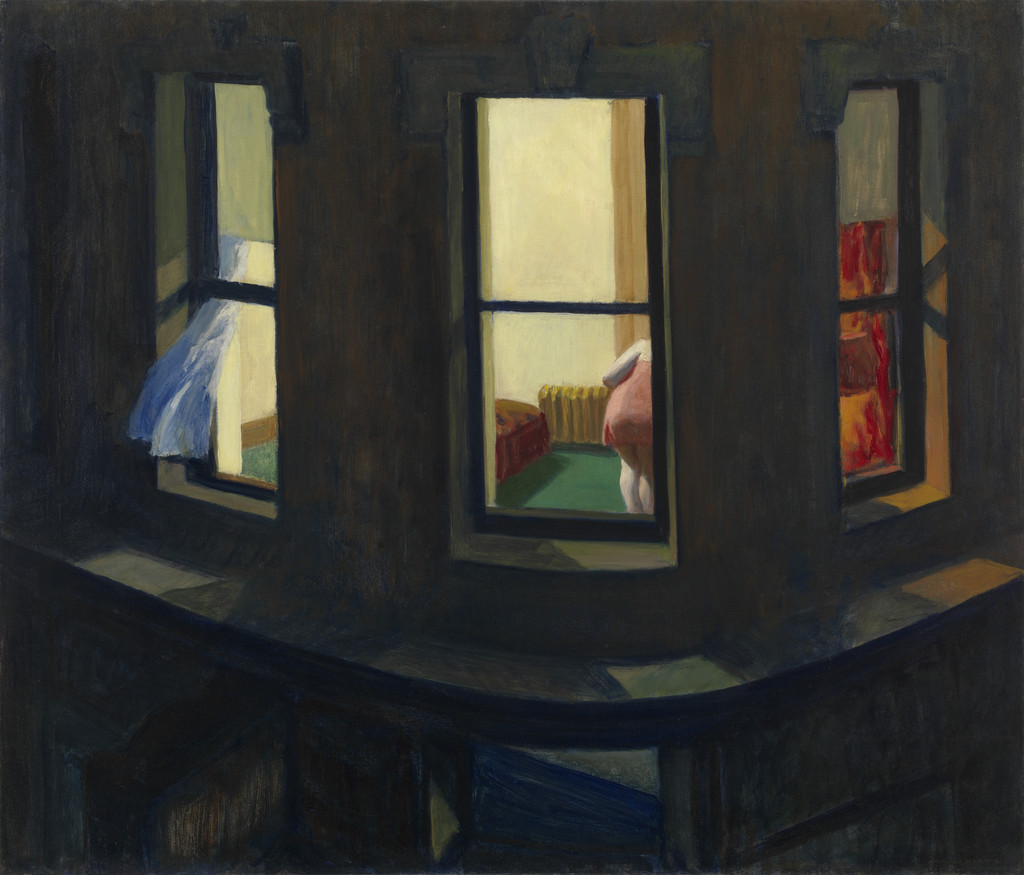
You're not supposed to be seeing this. That's the first thing the painting tells you — and the reason you can't look away. Hopper has placed you outside, slightly above street level, maybe on an elevated train rattling past a second-floor apartment. Three windows. A woman bent forward in the middle one, her back to you, her dress riding up past her hips. A curtain blowing inward on the left. A lamp glowing through a pulled shade on the right. You get fragments, not a story. You get a body, not a person.
The angle matters. Hopper doesn't give you the street. He doesn't give you a building facade or a skyline to orient yourself. He crops the scene ruthlessly — three rectangles of warm light floating in a wall of near-black. You are suspended in that darkness, looking in. The painting's composition does something a photograph can't: it locks you into the position of the voyeur without giving you any of the context that might excuse it. There is no narrative reason for you to be here. You just are.
Look at that curtain on the left. It's the only thing moving in the whole painting. The wind is pulling it outward, toward you, like some involuntary breath — the apartment exhaling into the night. It's a tiny detail, but it undoes the stillness. It reminds you there's real air in that room, a real temperature, a real life being lived on the other side of that brick. And you will never be part of it. The train keeps moving. The woman doesn't turn around. The curtain flutters for no one.
This is 1928 New York, a city where you could live stacked on top of a million people and never know a single one of them. Hopper understood that kind of closeness — how it sharpens loneliness instead of relieving it. He painted dozens of lit interiors, hotel rooms, diners, offices at night. But this one is the most honest about what those paintings are actually doing. They're watching. We're watching. And the ache isn't that the woman is alone. The ache is that we are this close, and it changes nothing.