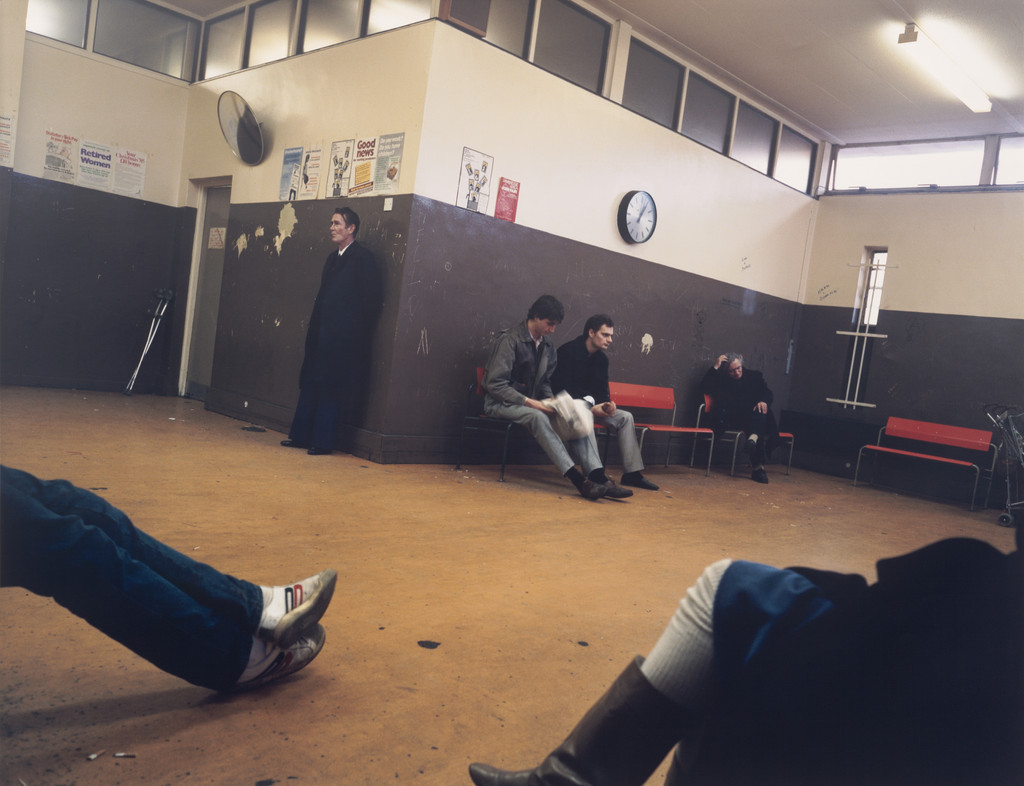
After the stillness we just left — that quiet, almost sacred emptiness — here is the room where most people actually spend their solitude. Not meditating. Not choosing silence. Waiting. Waiting because they have to, under lights that make everyone look a little sick, on chairs bolted to the floor.
Look at the walls. That two-tone paint job — cream above, scuffed green below — exists in every government building you've ever dreaded entering. It's a color scheme designed by no one, chosen for nothing, maintained by budget. The clock on the wall is the only authority in the room, and it moves at the speed the system wants it to, not at yours. Graham shot this in the mid-1980s, inside a Department of Health and Social Security office in East London — Thatcher's Britain, benefits under siege, the welfare state hollowed out and hostile. These offices were where unemployment met paperwork. You took a number. You sat. You did not complain, because complaining slowed things down.
The people here have arranged themselves the way strangers always do in rooms like this: pressed to the edges, a seat between each body where possible, eyes forward or down. Nobody is looking at anyone else. This isn't the loneliness of an empty room. It's the loneliness of a full one — of being surrounded by people who are all, individually, enduring the same small indignity, and who cannot afford to make it a shared experience. Community requires energy. This room has already taken it.
Graham was doing something radical at the time, though it doesn't look radical. He was pointing a camera at the welfare state and treating what he found with the seriousness of documentary photography — color film, large prints, careful framing — at a moment when the British establishment preferred not to see these rooms at all. The DHSS tried to stop him. They didn't want the waiting rooms photographed. Which tells you everything about what these rooms were: not places designed for people, but holding pens designed for processing. The photograph is evidence. Not of poverty as spectacle, but of the specific, grinding texture of institutional time — time that belongs to someone else.