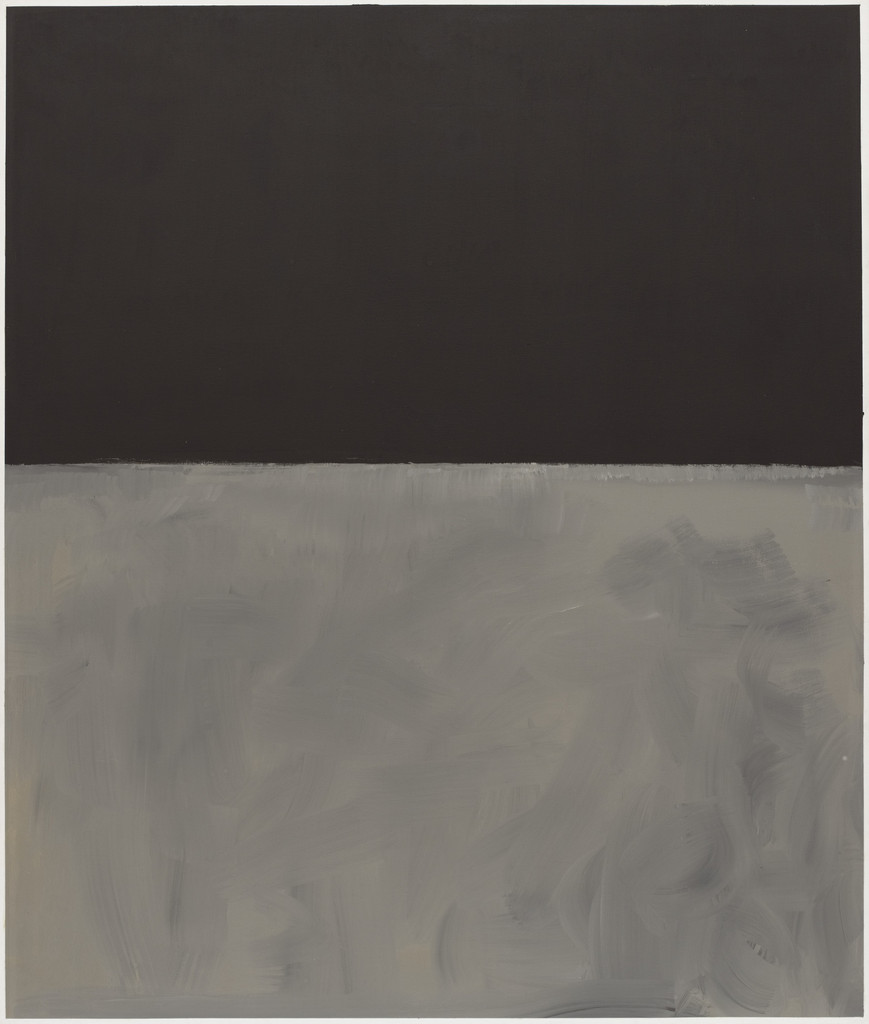
We started this tour looking at people who were alone. Now there are no people. No rooms. No windows letting in gray light, no chairs waiting to be sat in, no counters dividing one stranger from another. Just this: a black field over a gray field, divided by a line so soft it barely holds.
That line. Look at it. It isn't sharp — it bleeds. The black seeps into the gray, or the gray rises into the black, and you can't say with certainty where one ends and the other begins. Rothko painted this in 1969, the last full year of his life, and the palette had been narrowing for years. Red went. Orange went. Yellow went. What remained was this: the simplest possible statement about division. Sky and ground. Presence and absence. Here and not here.
Stand with it for a minute. Not in front of it — that's the wrong preposition. Stand in it. Rothko built these paintings at human scale deliberately. Eighty inches tall: roughly the height of a door, roughly the height you need to feel enclosed rather than observed. He wanted the edges of the canvas to disappear from your peripheral vision. He wanted you inside the color. And what's inside this color is weight. The black is not vacant. It's saturated, heavy, bearing down on that gray the way a long silence bears down on a room after someone has left it.
Everything we've seen on this tour — Hopper's etching of a woman by a window, the strange hush of bedrooms and waiting rooms, the architecture of being apart — all of it was leading here. Loneliness, it turns out, doesn't need a setting. It doesn't need a body. Given enough space and enough honesty, it becomes its own atmosphere. You stand inside it and recognize it the way you recognize weather. Rothko didn't paint loneliness. He made the room loneliness makes when there's nothing left to describe.
I won't tell you what to feel. Rothko never did either. He just said that if you were moved, you were having the same experience he had when he painted it. That was enough for him. It should be enough for us.
When did you last feel this full kind of emptiness — not the absence of something, but the presence of nothing else?