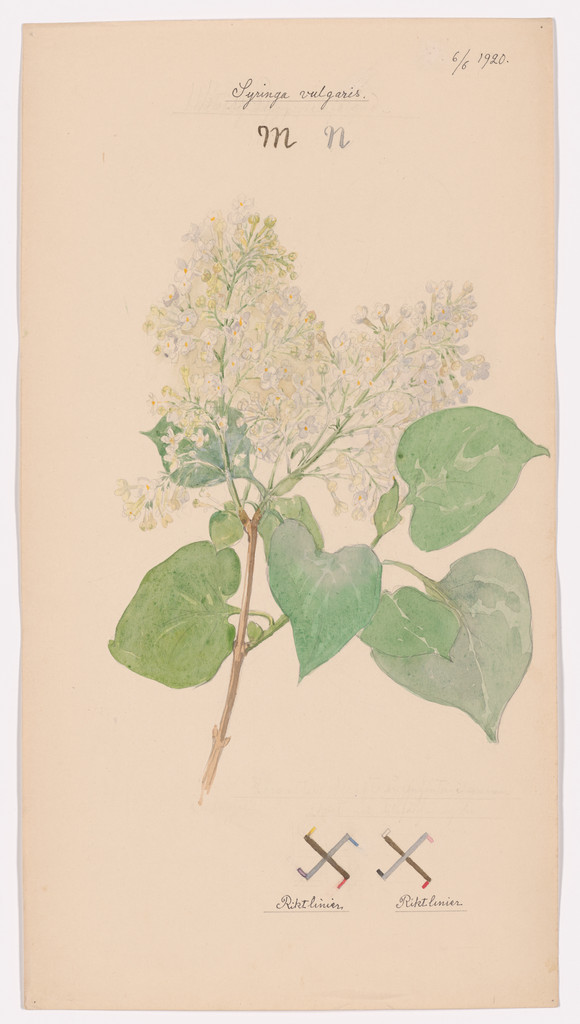
June 6, 1920. She wrote the date at the top of the sheet, the way you'd write it in a diary. And that's almost what this is — a diary entry about a lilac branch, made by a woman who believed that looking hard enough at a flower could crack open the surface of the world.
The branch itself is rendered with real botanical attention. Each cluster of tiny florets fans out in its pyramidal cone, the purple darkening toward the center where the petals are still furled and lightening at the edges where they've opened to the air. The leaves are broad and heart-shaped, just as they are, painted in a green so specific you can tell it's early summer. Af Klint is not improvising. She is recording. The kind of looking that takes an hour to produce a single leaf, where you keep glancing up from the paper to check — is that vein really there? Does the stem really bend that way? It does.
But then, beneath the botanical study, she adds something else. Two small symbols in metallic pigment — compact, geometric, not quite legible. They sit below the lilac like a footnote in a language she was still learning. Af Klint belonged to a circle of five women in Stockholm who held séances, kept spiritual notebooks, and believed that the natural world was a kind of alphabet. The lilac was not only a lilac. Its purple was a frequency. Its structure was a message. Those small symbols are her attempt to write down what the flower was saying.
This is the thing that makes af Klint hard to dismiss and hard to categorize. She is not choosing between precision and faith. She draws the flower with the patience of a field botanist, counts its petals, notes the date and the species in Latin. And then she kneels a little deeper into the looking and records something else — something she couldn't photograph, couldn't press between the pages of a book. The purple here is not decorative. It is evidence. Of what, exactly, she wasn't entirely sure. But she trusted the color to hold it.
After Kelly's painted square, where purple was given to us as a pure, self-contained fact, af Klint opens the door that sits behind the fact. Purple in nature. Purple as it actually grows — on a branch, in June, in Sweden, observed by someone who thought the visible world was only the first layer.