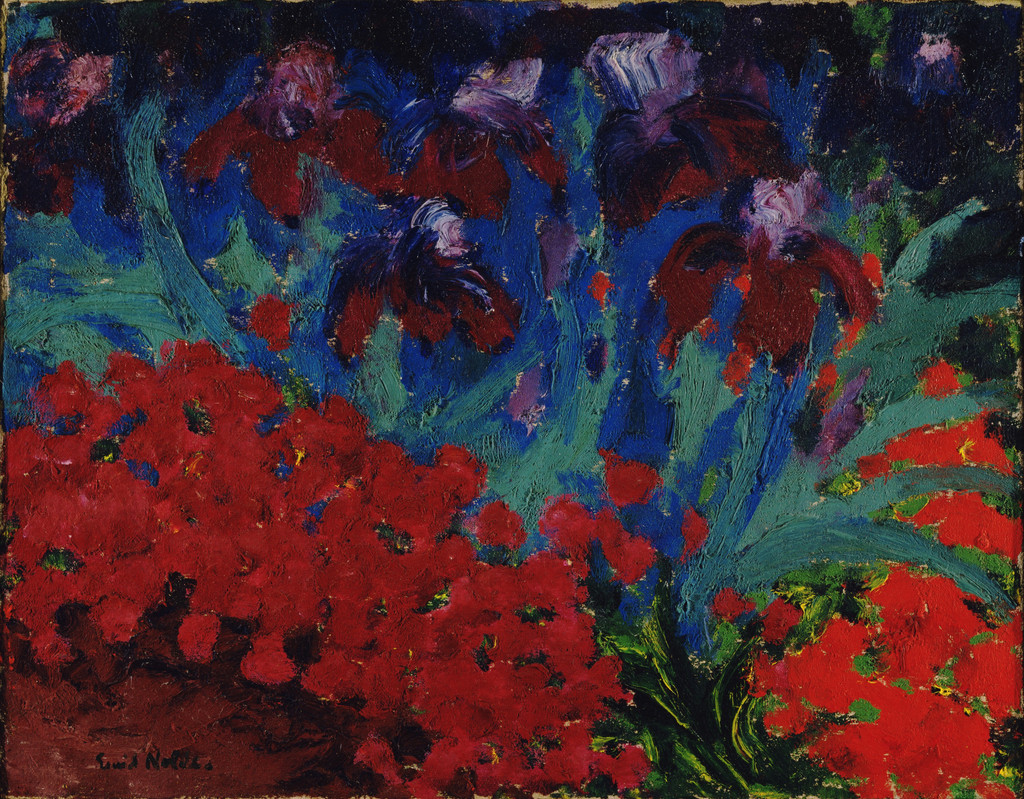
He didn't paint these flowers. He pressed them into the burlap like a man pressing a wound closed. Look at the surface — that's not canvas, it's rough-woven sacking, the kind you'd find in a barn or a field hospital. The weave shows through everywhere. It drinks the paint unevenly, refuses to behave. Nolde chose it anyway. Maybe he needed something that would fight back.
It's 1916. Half of Europe is dying in trenches. And Nolde is in his garden in northern Germany, dragging pigment across burlap, painting flowers. But these aren't the flowers of someone ignoring catastrophe. The reds don't sit beside the purples — they collide. That central bloom isn't opening; it's detonating. Deep violet pushes against hot red, and the blue at the edges presses in like bruised sky. Every color here is at full volume, shouting over the others. The green leaves don't frame or support — they slash upward, raw and jagged, more like hands reaching than foliage resting.
Count the brushstrokes you can actually see. Dozens. He left every one visible. No blending, no smoothing, no polishing the feeling away. Each mark is a decision made fast and left alone. This is a man who understood that tenderness, real tenderness, sometimes looks like violence. You don't gently arrange flowers when the world is ending. You grab them. You smash color onto whatever surface you have. You make something exist that the next shell could erase.
Until now on this tour, purple has been contained — a clean square, a spiritual diagram. Here it breaks loose. It runs hot, bleeds into neighboring colors, refuses its edges. This is purple as pulse, as pressure. Not a concept. A feeling in the body, painted by a body, on a material the body can almost feel through the screen.
What would it feel like to touch this surface — and why does that impulse hit so hard with this painting?