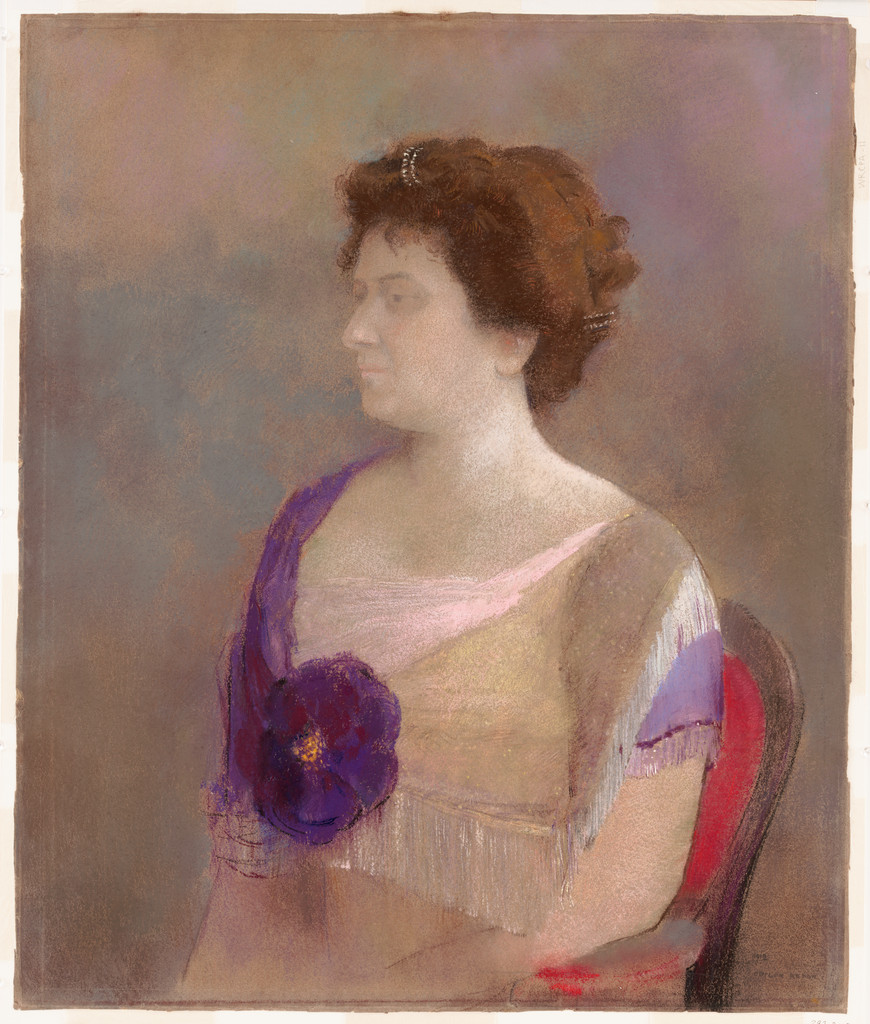
She isn't looking at you. She may not know you're here. Redon has given us someone mid-thought — seated, turned slightly away, her gaze aimed at something beyond the edge of the paper or maybe at nothing external at all. The whole composition has the hush of a room where someone has been sitting alone for a long time.
Almost everything here is soft to the point of dissolving. Her skin, her hair, the background — all of it rendered in chalky mauves and taupes that seem to be losing their hold on form, drifting toward abstraction the way a face goes vague in memory. Redon worked in pastel for pieces like this, and you can feel the material's nature in every passage: powder held to paper by friction and nothing else. The image looks like it could be brushed away.
Except for the flower. Pinned at her shoulder, it's the one passage where purple gathers itself into something definite — a corsage or bloom, saturated enough to anchor the entire picture. Everything else recedes. This stays. It's a small thing, really. A spot of color no larger than a few inches. But against all that atmospheric drift, it becomes the loudest element in the room without raising its voice. It's adornment as quiet declaration — something chosen, worn deliberately, held close to the body.
Redon spent decades drawing nightmares. Eyeballs floating in voids, spiders with human faces, flowers growing from skulls. By the time he made this, around 1905, he had moved almost entirely into color — pastels and oils full of petals, butterflies, women lost in thought. People sometimes call it his "late optimism," but that misses what's actually happening. He didn't abandon darkness. He internalized it. The fog in this picture isn't cheerful. It's the fog of someone's inner life, and the purple flower is the single point where private feeling becomes visible to the outside world.