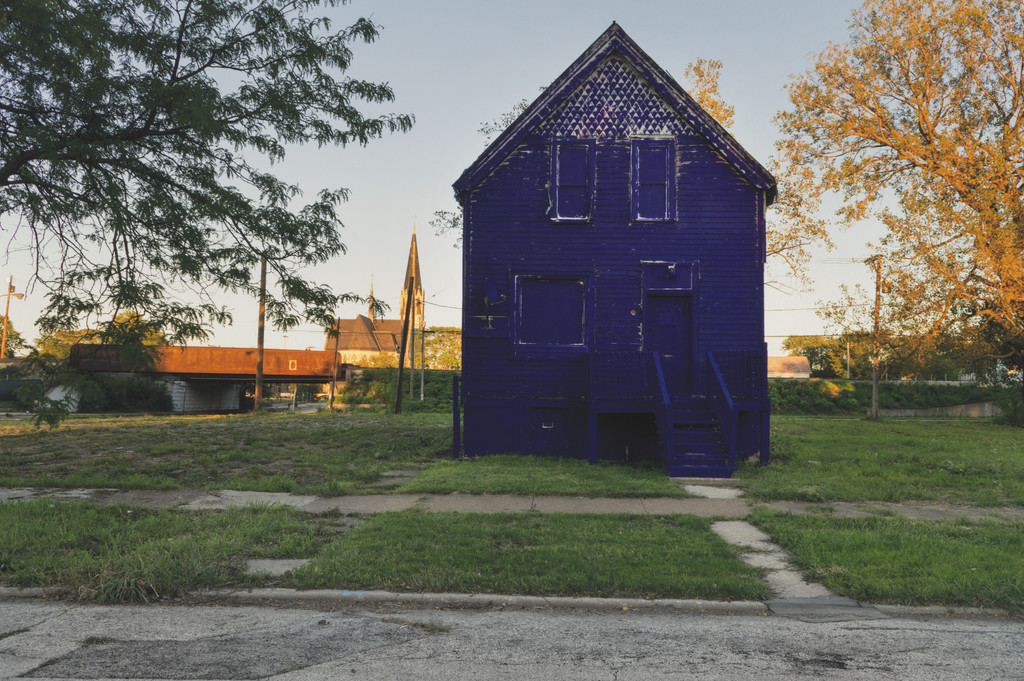
That is a house. A real house on a real block on the South Side of Chicago. Amanda Williams painted it the exact purple of a Crown Royal whisky bag — that soft, drawstring-cinched velvet pouch that shows up in corner stores and kitchen cabinets and car floors across Black neighborhoods nationwide. You know the color if you know the color. If you don't, that's part of the point.
The house was condemned. Slated for demolition. One of thousands across Chicago's South Side, emptied by decades of redlining, disinvestment, population loss. These houses disappear so quietly that most of the city never notices. Williams made this one impossible to ignore. She covered it in saturated purple and then stepped back and let the camera do the rest — the bare trees, the dry grass, the open sky, the neighboring lots already cleared to nothing. The golden light is almost cruel in how beautiful it makes the scene.
Here's the thing Williams understood: color was already doing work on this block. Not her purple — the other colors. The faded paint, the plywood gray, the beige of neglect. Those are colors too, and they communicate. They say: nothing worth saving here. They say: drive past. Williams swapped one code for another. Crown Royal purple registers instantly in the communities where this house stands. It's specific. It's branded. It's a luxury marketed to people whose houses get torn down. Painting the house this color doesn't beautify it. It names a system.
So now purple has a problem. For four stops you've watched it do elegant things — fill a square, bloom in a garden, combust on a canvas, soften around a woman's shoulders. Here it can't be any of that. It's a commodity color printed on velvet and sold at a markup. It's the gap between what a brand promises and what a neighborhood gets. Williams didn't choose purple because it's beautiful. She chose it because it already belonged to this place, and nobody with power was paying attention.
The house is gone now. Demolished, like it was always going to be. The photograph is what remains — which raises its own question about what we preserve and in what form.