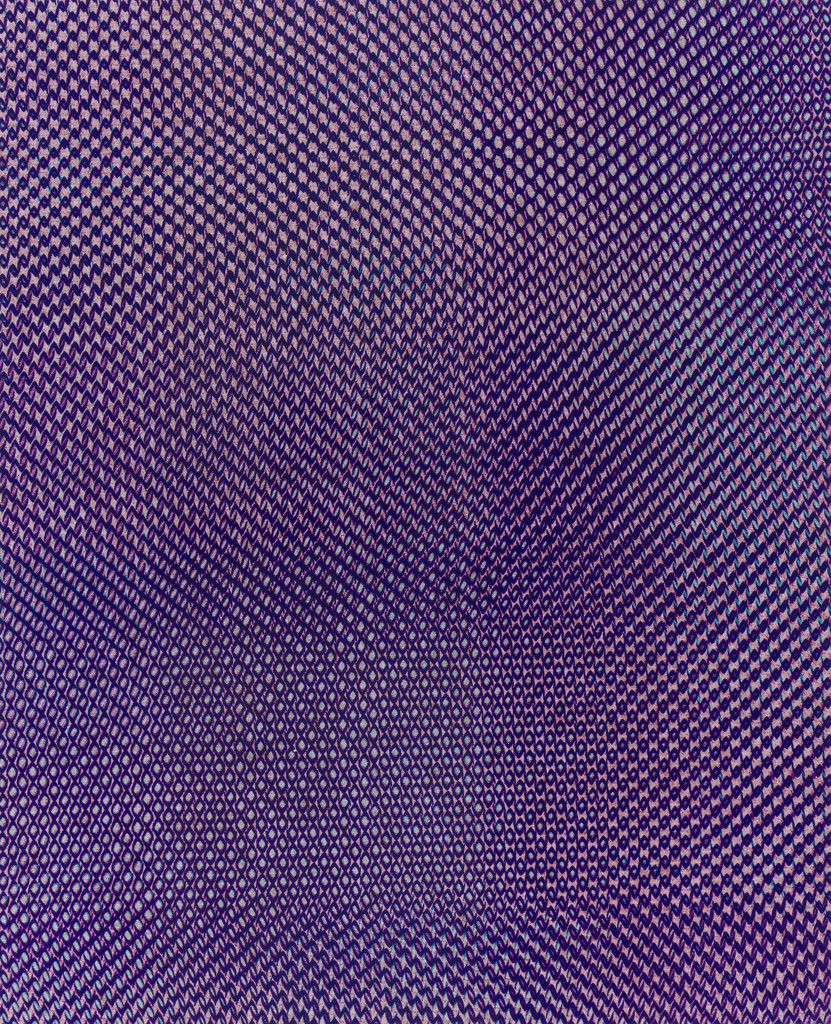
No camera made this. Oppenheim laid fabric — real African wax-print cloth, the kind sold in markets from Lagos to Brixton — flat against photographic paper and turned on the light. Light passed through. Light stopped. Light bent around every thread. What printed is not a photograph of fabric. It is fabric's shadow, recorded at a molecular level.
Look at the chevrons. They repeat. They repeat. They repeat until your eye gives up trying to track any single one and surrenders to the field. Purple darkens to violet. Violet pales to pink. Pink warms to mauve. Mauve cools back to purple. The color has no center. It shifts depending on where you anchor your gaze, the way a word repeated too many times loses its meaning and becomes pure sound.
The source cloth — "Véritable" wax print — has its own tangled history. Designed by Dutch manufacturers. Printed for West African markets. Absorbed so completely into local fashion that it became African, became identity, became pattern-as-language. Oppenheim's photogram strips the cloth of its function, its commerce, its geography. What's left is structure. Scale after scale after scale, like the skin of something alive and iridescent.
There's a discomfort here if you stay long enough. The surface is gorgeous — undeniably, almost aggressively gorgeous — but it won't resolve into a picture. It won't give you a figure, a horizon, a focal point. It gives you repetition and shimmer and the slow realization that your eyes are doing all the work. Purple, in this room, is not symbolic. It is not spiritual. It is not personal. It is optical. A wavelength catching and releasing across ten thousand tiny chevrons, and you, standing in front of it, trying to hold still while the image vibrates.