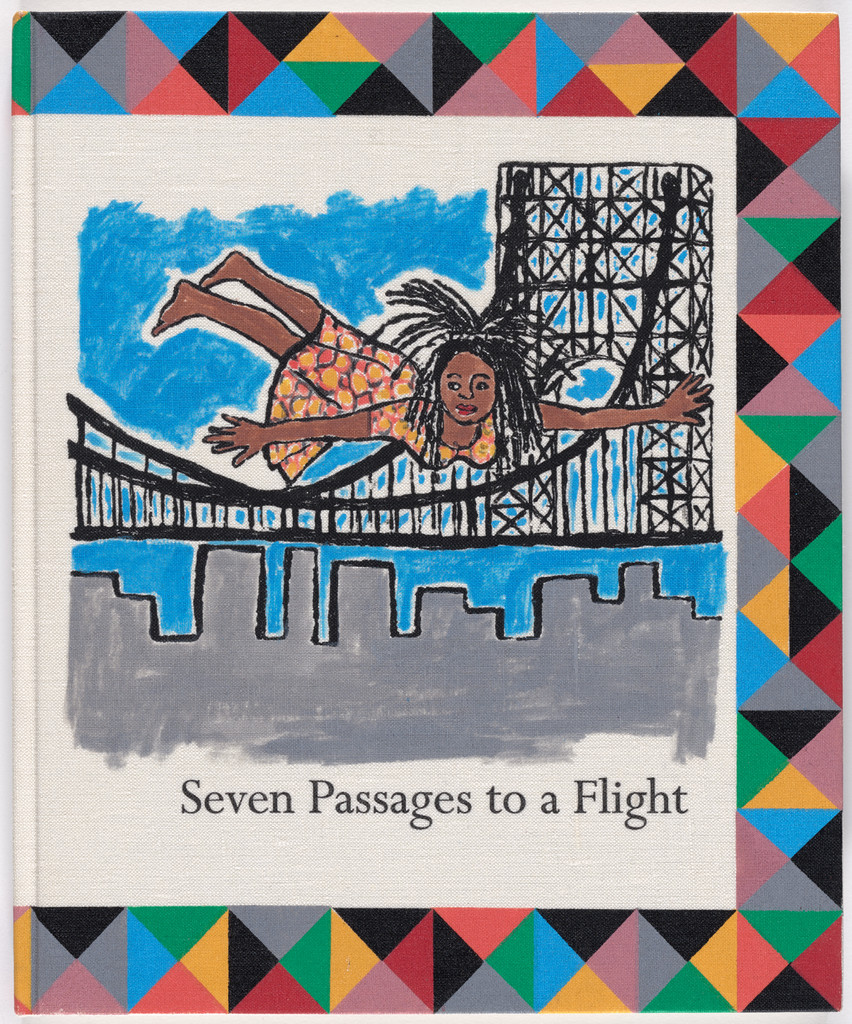
She is flying. Not falling, not floating, not being carried — flying. Her body is horizontal over the George Washington Bridge, arms open, and the city below her is a field of lights she has decided belongs to her. Faith Ringgold painted this woman the way a child tells you something impossible with total certainty: I flew over the bridge last night. I claimed it. It's mine now.
Ringgold grew up in Harlem, on the roof of her apartment building — Tar Beach, she called it, because the roof was paved with tar and in summer that's where families went to eat and talk and sleep under the sky. From up there, you could see the George Washington Bridge lit up like a necklace. The bridge was built by men who looked like her father, steel workers who were kept out of the union because they were Black. So when Ringgold's girl flies above the bridge, she is not escaping. She is taking possession. There is a difference.
Look at the border. Ringgold trained as a painter but turned to fabric because she wanted her art to carry the memory of women's hands — her mother was a fashion designer in Harlem, and her grandmother had quilted. The triangles that frame this scene are stitched in purple, red, blue, green, and they do what a frame is supposed to do: they hold the world inside them safe. This is not a painting with a border added. The quilt is the architecture of the story. It says: what happens inside here is protected. It can be as impossible as it needs to be.
We started this tour with a purple so pure it refused to mean anything beyond itself. We passed through purple as spirit, as fury, as inner life, as brand, as shimmer. Here, at the end, purple is one bright triangle among many — not the whole story, just part of the celebration. Ringgold doesn't isolate color. She quilts it together with everything else: narrative, pattern, family, flight. Purple doesn't need to carry weight alone. It shares the load.
This is the image to leave with. A woman in the air above a city that tried to keep her family on the ground. A quilt border that says: this story is stitched tight, it will hold. And the particular courage of declaring joy — not as naïveté, not as denial, but as a reclamation so fierce it looks, from a distance, like a children's book. It isn't. It is an adult woman deciding what is possible.
What would you fly over — and what would you claim when you got there?