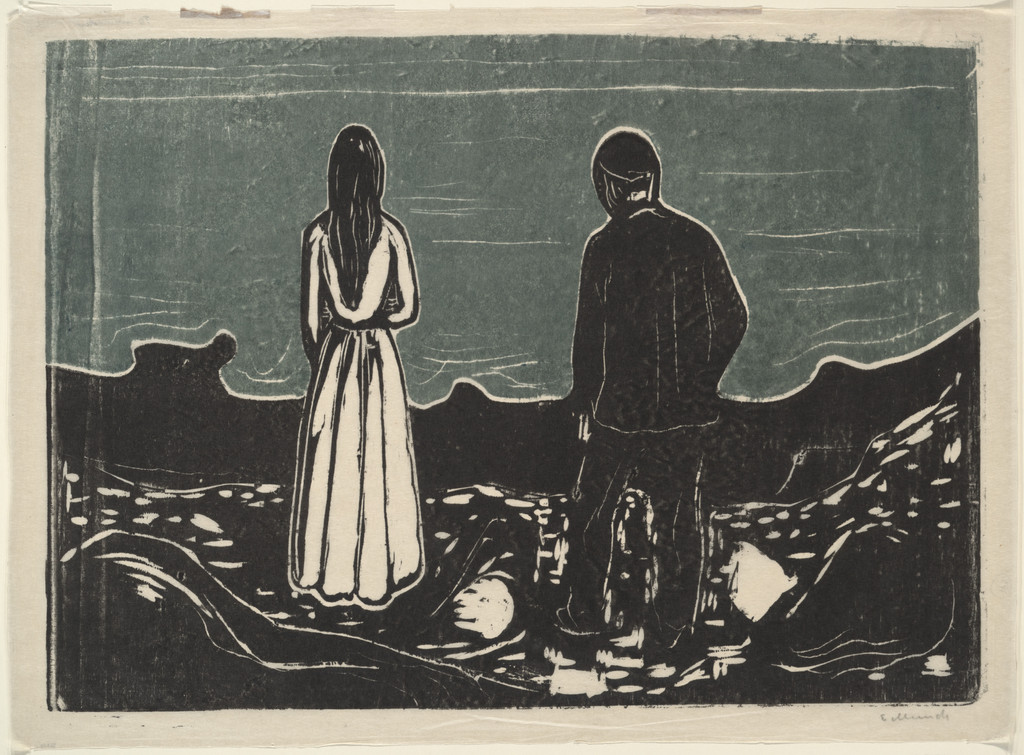
Two People. The Lonely Ones To mennesker. De ensomme
Edvard Munch
1899 · Woodcut
15½ × 21¾ in.
1899 · Woodcut
15½ × 21¾ in.
What does loneliness look like
when two people stand side by side?
That space between them — have you ever stood in it? Not alone, exactly. But not together either. What did that feel like?
Munch answered your question more than a century ago. He carved it into wood.
Look at what he gives us: two backs. We will never see their faces. We are behind them, with them, watching the same cold water — and yet we know, immediately, that they are not watching it together. The woman in her pale dress, hands clasped. The man, dark and hunched, slightly apart. Both facing the sea. Neither facing each other.
This is a woodcut — meaning Munch carved away everything that is not the image. He cut into the grain of the wood and left these two figures standing on what remains. There is something honest about that process: you don't add loneliness to a picture. You remove everything that would conceal it.
The shoreline beneath them churns with texture — those pale, scattered marks like stones catching light, or maybe restless thoughts made visible. But above, the teal horizon is vast and still. The world is indifferent to whatever silence lives between them.
Munch returned to this composition obsessively — in drypoint, in paint, in woodcut after woodcut — across decades. He couldn't leave it alone. As if the image of two people failing to reach each other, while standing close enough to touch, was a wound he kept pressing to see if it still hurt.
It still hurts.