A different kind of portrait
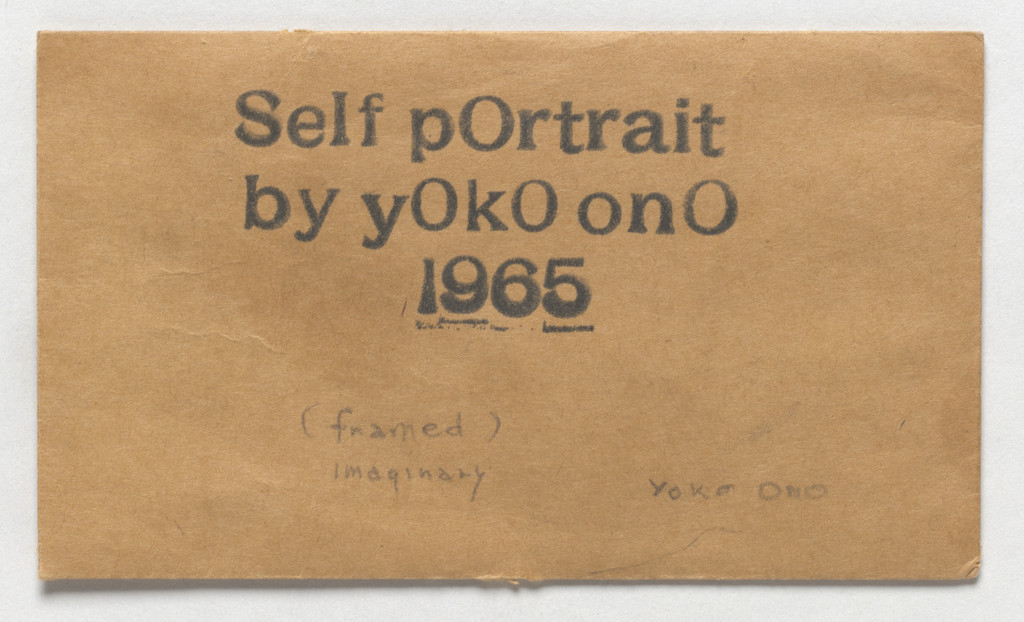
This is a self-portrait of Yoko Ono. But Yoko Ono is not in it. Instead,
there's a mirror. A small, cheap, metal mirror tucked inside a brown paper envelope
that's been stamped with ink and scribbled on in pencil.
When you open the envelope and look into the mirror, you see your face.
Not hers. Yours. Which means that Yoko Ono's self-portrait is actually a portrait of
whoever is looking at it. Including you.
This is what the Fluxus artists did in the 1960s — they made art out of
instructions, jokes, ordinary objects, and ideas. They believed that art didn't have
to be precious or permanent. It could be a gesture. A thought. A mirror in an envelope.
Ono made this work the same year she published her book Grapefruit, which was
full of instruction pieces like "Draw a map to get lost" and "Imagine the clouds dripping.
Dig a hole in your garden to put them in." Art as a set of possibilities. Art as something
you complete in your mind.
So when she makes a self-portrait that's actually a mirror, she's asking:
What is a self? Is it fixed? Is it something you own? Or is it
something that changes depending on who's looking, who's asking, what moment you're in?
We've moved through separation, fragility, fusion, ashes, and germination. You've been
watching other people's images of loneliness and connection and transformation.
But now — now — Ono hands you a mirror and says: your turn.
Who do you see?