Three artists who never met, drawing the same pattern fifty years apart
scroll
Eva Hesse
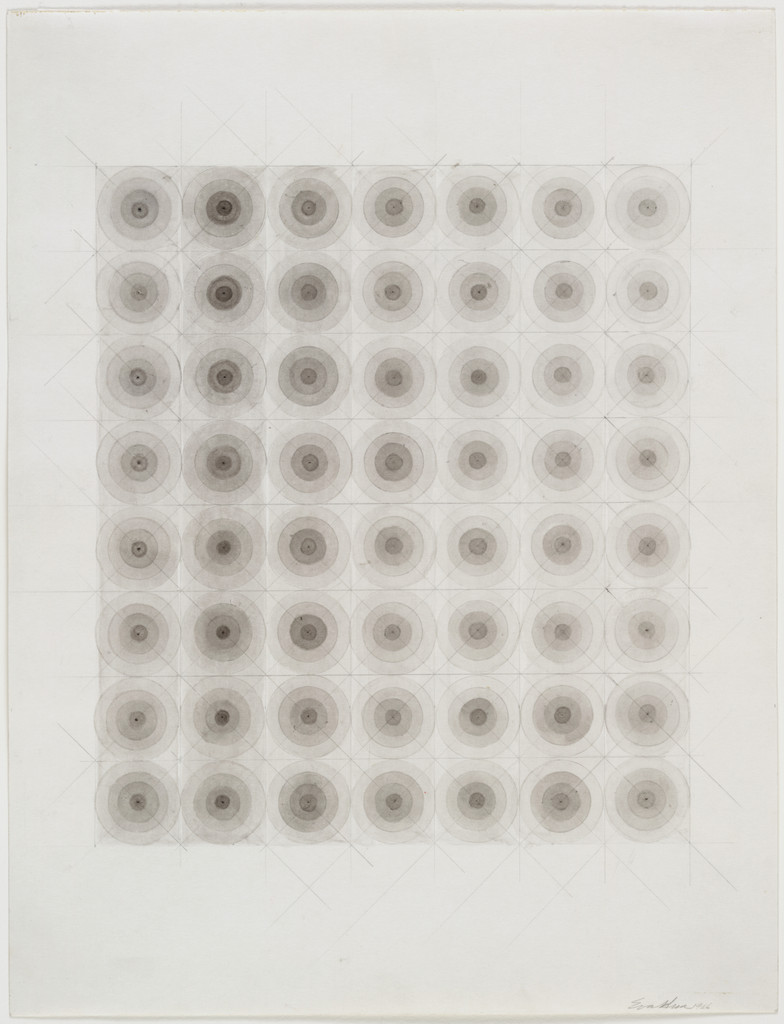
No title, 1966
Watercolor and pencil on paper
11 ¾ × 9 ⅛ inches
American, born Germany · 1936–1970
Look at how quiet this is.
Fifty-six circles. Each one drawn by hand — concentric rings radiating from a dark center, nested inside a penciled grid. The system is strict. The hand is not. Every circle wobbles differently. Every ring breathes at its own pace.
Eva Hesse was thirty when she made this. She had four years left to live. She didn't know that, of course. She was thinking about seriality — the way repeating a form doesn't dull it but charges it, the way the fiftieth circle is not the same as the first even if the rule hasn't changed.
Here's what I want you to hold as we walk through this tour: this pattern — the concentric circle, the target, the ripple — appears across decades, across continents, drawn by people who never shared a room. The same form, arriving independently. As though the shape itself were the artist, and the hands merely its instruments.
We begin here, with Hesse, because she understood that repetition is not the same as sameness. Each of these circles is a small act of faith — that doing it again will reveal something the last time didn't.
When you look at these circles — all alike, all different — what does the repetition feel like to you? Meditative? Obsessive? Something else?
Look at how quiet this is.
Fifty-six circles. Each one drawn by hand — concentric rings radiating from a dark center, nested inside a penciled grid. The system is strict. The hand is not. Every circle wobbles differently. Every ring breathes at its own pace.
Eva Hesse was thirty when she made this. She had four years left to live. She didn't know that, of course. She was thinking about seriality — the way repeating a form doesn't dull it but charges it, the way the fiftieth circle is not the same as the first even if the rule hasn't changed.
Here's what I want you to hold as we walk through this tour: this pattern — the concentric circle, the target, the ripple — appears across decades, across continents, drawn by people who never shared a room. The same form, arriving independently. As though the shape itself were the artist, and the hands merely its instruments.
We begin here, with Hesse, because she understood that repetition is not the same as sameness. Each of these circles is a small act of faith — that doing it again will reveal something the last time didn't.