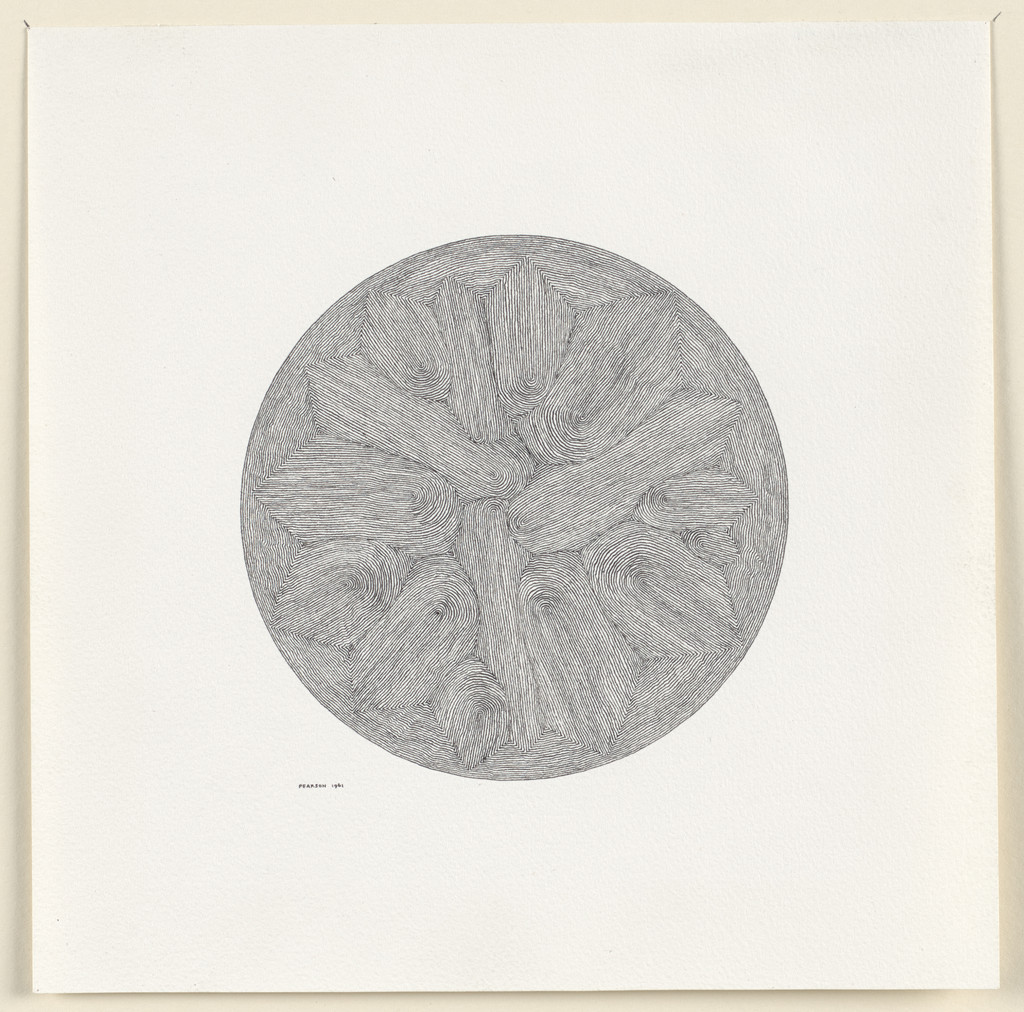
In 1961, Henry Pearson — an American painter who lived to 92 — made this drawing. Eva Hesse was 25 years old that year, still in school. They never met. They worked in different cities, moved in different circles. And yet.
This drawing is small: 10 inches tall.
The circle measures exactly 5 5/8" across.
Inside are hundreds of individual pen strokes, each one made by Pearson's hand in 1961.
Do you think it's possible for a shape — a circle, a spiral, a grid — to choose the artist, rather than the other way around?
This circle is exactly 5 5/8 inches in diameter. Pearson titled it that way — as though the measurement were the point, as though precision could contain what the hand does inside it.
But look at what the hand did. Hundreds of tiny pen strokes, each following the curve of the one before it, building up swirls and eddies like a fingerprint, like water circling a drain, like something alive.
The circle is perfect. The line that makes it is steady and ruled. But inside? Inside is evidence of time passing — stroke after stroke, hour after hour, the pen moving in small rotations, building density and rhythm.
Pearson worked for decades making circles like this. Filling them with marks. Hesse, five years later, would build her grid of concentric rings. Neither knew the other. The circle found them both.
What does it mean when two people, working alone, arrive at the same form? Is it coincidence? Is there something in the circle itself — some gravitational pull — that draws the hand toward it?