We've seen three artists — Pearson, Hesse, Bourgeois — arrive at the same patterns across decades. But they're not alone. Walk through any museum and you'll find it: the impulse to repeat.
What is repetition doing? What does it give us that a single mark cannot?
Repetition is not sameness. It's the opposite.
It's how difference becomes visible.
Have you ever done something repetitive — not because you had to, but because you needed to? Knitting, running, practicing scales, copying a word over and over?
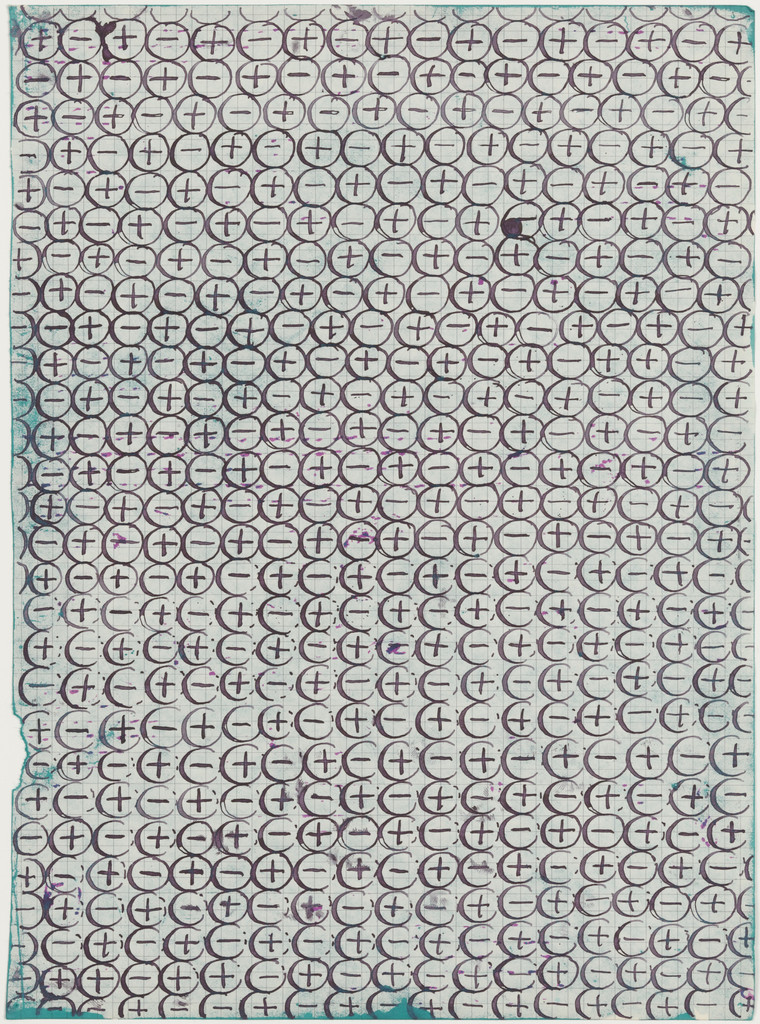
Look at this from across the room and it reads as a machine-made grid — uniform, systematic, cold.
Come closer. Now you see: every circle is drawn by hand. Every plus sign, every minus sign. The pen wobbles. The ink bleeds. There are smudges, stains of turquoise, places where the pressure changed.
David Moreno sat down with graph paper and a pen and drew this. Circle. Plus. Circle. Minus. Circle. Plus. Over and over. Row after row. How many? Hundreds. Maybe more than a thousand.
Why would anyone do this? What does it mean to spend hours — days? — making the same mark?
Maybe repetition is how we measure time without a clock. Maybe it's how we prove to ourselves that we were here, that we lasted, that our hand moved and left evidence. Maybe it's meditation. Maybe it's obsession. Maybe it's both.