"A world without objects, without interruption… or obstacle. It is to accept the necessity of going into a field of vision as you would cross an empty beach to look at the ocean."
When you stare at a grid long enough, something happens. The pattern dissolves. The lines stop being lines. You're no longer looking at the grid — you're looking through it.
Martin believed this is what art should do: not show you something, but make you ready to see. The grid is a door. Repetition is how you walk through it.
We've seen why artists reach for the same patterns. We've seen how repetition measures time and makes variation visible. Now we've seen what repetition can become: not just a practice, but a discipline. Not just a pattern, but a pathway.
Have you ever stared at something so long it stopped being a thing and became something else — a rhythm, a feeling, a kind of emptiness?
Agnes Martin drew grids for forty years.
Not as a formal exercise. Not as a conceptual system. She drew them because she believed the grid was sacred — a path to something beyond words. She called her work a representation of devotion to life.
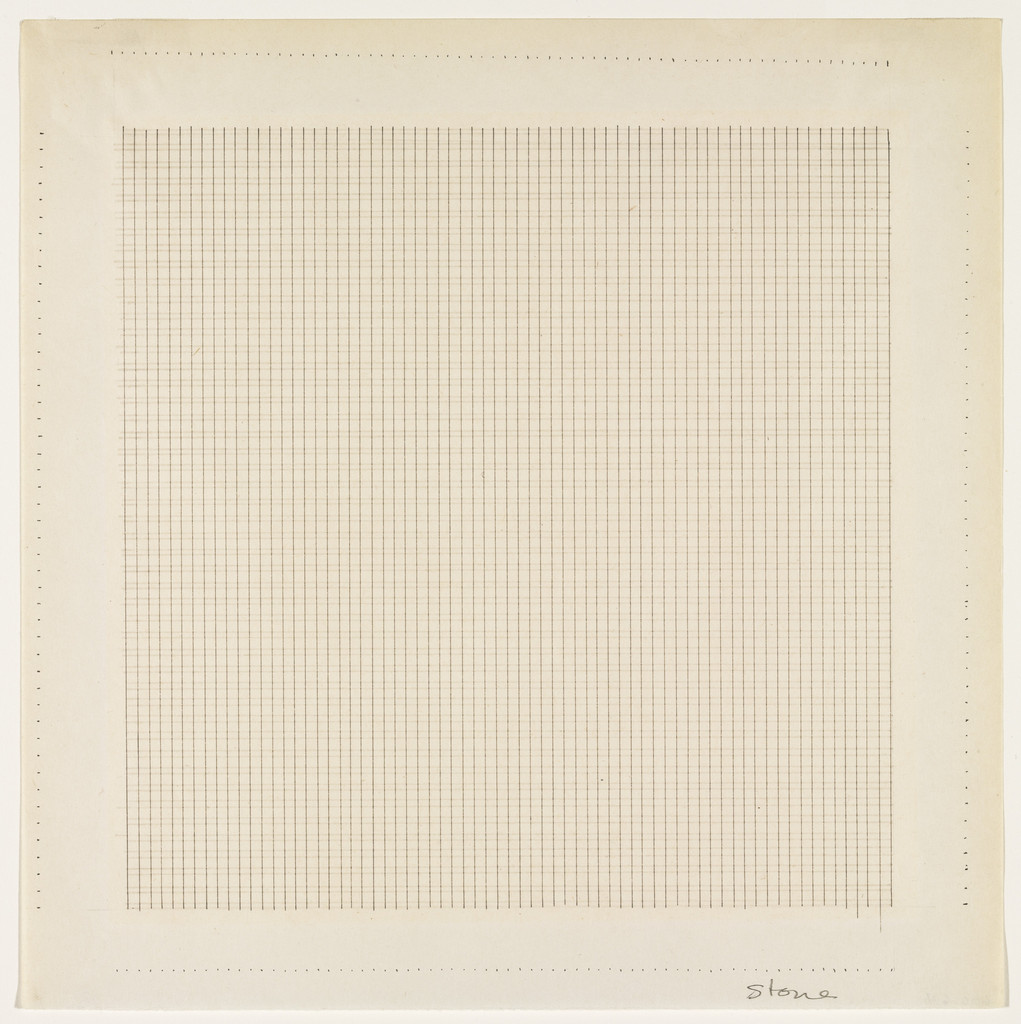
This drawing from 1964 — titled simply "Stone" — is barely there. From a distance it looks blank, a warm square of paper. You have to come close. Then you see: hundreds of faint pencil lines, horizontal and vertical, drawn by hand with a ruler. The grid is perfect. The hand is not. Every line trembles just slightly.
Look at the edges. See those tiny holes? Martin pinned the paper down before she drew. She wanted it still, held, reverent.
For Martin, repetition wasn't obsession. It was meditation. Each line was an act of attention. Each grid was a clearing — a way to empty the mind and make room for something larger.