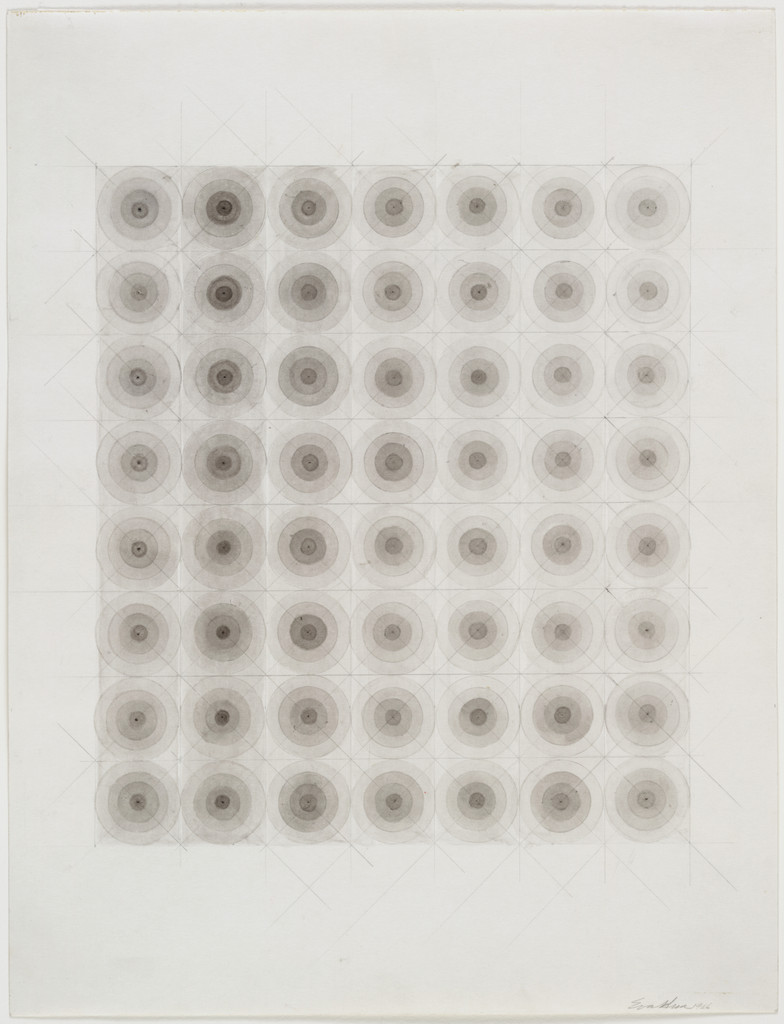
We began this tour with Eva Hesse's grid of fifty-six circles. We talked about the pattern, the synchronicity, the fact that she arrived at this form. But we didn't talk about what matters most.
Perfection is machine work. The wobble — the slight deviation, the hand betraying itself — that's where we are.
Maybe that's why we keep drawing the same patterns, across decades, across continents, without ever meeting. We're not trying to make them perfect. We're trying to see how close we can get — and what the distance reveals.
When you try to do something perfectly and fail — what does the failure show you about yourself?
Look at these circles now. Really look.
None of them are perfect. Every ring wobbles. Some are darker, some lighter. Some rings don't quite close. The spacing between them shifts. The pencil grid that holds them — look at those construction lines — they're not straight either.
Hesse tried to make them identical. She used a ruler. She measured. She followed a system. And the system failed. Not because she was careless. Because she was human.
This is the secret at the heart of all the patterns we've seen: the wobble is the point.
Agnes Martin's grids tremble. David Moreno's circles smudge. Louise Bourgeois's spiral refuses to be smooth. Henry Pearson's ink bleeds.