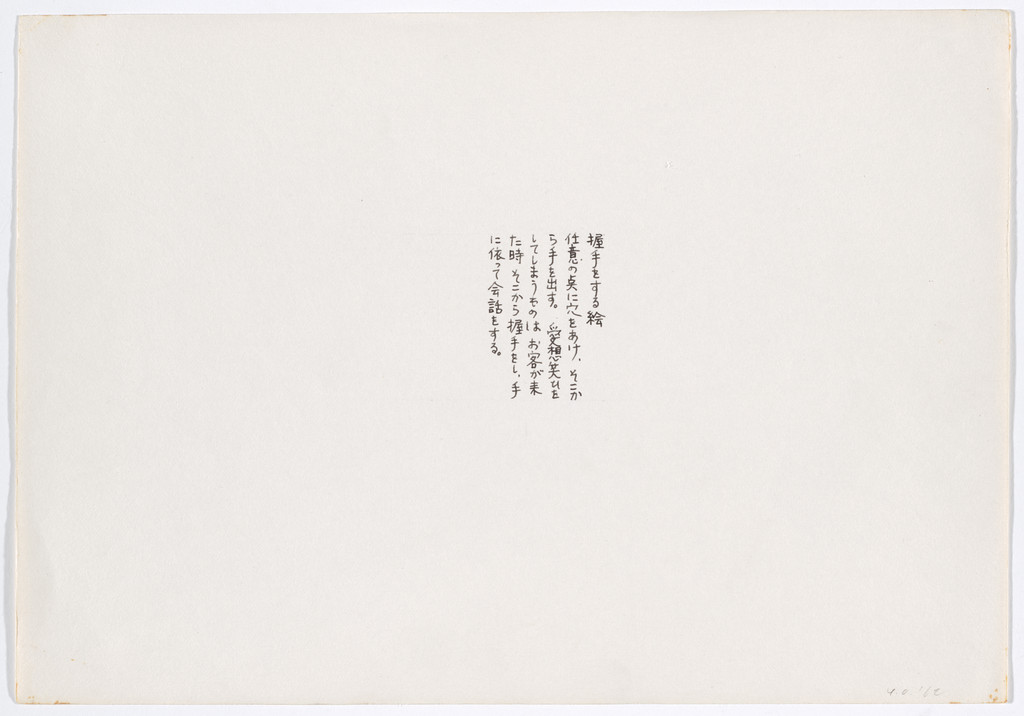
Shake hands with people who come to see the painting.
The painting is the handshake. The art is the connection.
Three artists who never met, drawing the same pattern fifty years apart. We asked: why? Maybe because certain forms are older than us. Maybe because the hand remembers what the mind forgets. Maybe because repetition is how we measure time, prove we were here, find our rhythm.
Or maybe it's simpler: we keep drawing circles because we're looking for connection. And the wobble — the imperfection, the human tremor — that's not a failure. That's the signature. That's how we recognize each other.
Now it's your turn.
Go find someone.
Shake their hand.
The tour is over. The pattern continues.
This is not a drawing. It's an instruction.
Yoko Ono typed it in Japanese in 1961, five years before Eva Hesse drew her circles, the same year Henry Pearson filled his circle with pen strokes. It says, simply: "Shake hands with people who come to see the painting."
That's it. That's the whole work. Not what's on the paper — what happens when two people reach for each other.
We've spent this tour looking at patterns: circles that repeat, grids that breathe, spirals that coil inward. We've seen how artists across decades arrive at the same forms. We've seen the wobble, the human hand failing to be perfect.
But here, at the end, Ono asks: what if the pattern isn't on the paper? What if the pattern is between us?