Look at his face. Not at the buttons — not yet. Just the face. He can't be more than seventeen. There's something in that gaze that Arbus found over and over: a person performing certainty, and the camera catching the thinnest seam where the performance doesn't quite hold.
He's dressed for it. The straw boater, the bow tie, the suit — all the costuming of a conviction inherited, not earned. In his left hand, a small American flag. On his lapel: BOMB HANOI. On his chest: GOD BLESS AMERICA / SUPPORT OUR BOYS IN VIET NAM.
This is 1967. Next year, Martin Luther King Jr. will be assassinated. Bobby Kennedy will be assassinated. The Democratic Convention in Chicago will erupt into violence on live television. Prague Spring will bloom and be crushed by Soviet tanks. Students will occupy universities from Columbia to the Sorbonne. The Tet Offensive will shatter any remaining illusion that the war is being won.
But right now, this boy is waiting. He hasn't marched yet. He's standing still, in front of Arbus's waist-level Rolleiflex, and something in that stillness is the whole story.
"A photograph is a secret about a secret. The more it tells you the less you know." — Diane Arbus
Arbus didn't photograph protesters. She photographed this boy — the one on the other side, the one who dressed up and showed up to say yes to a war that was already tearing the country apart. She found the uncanny not in the margins but in the mainstream. She looked at patriotism the way she looked at everything else: with a gaze that was intimate, unblinking, and entirely without judgment.
We begin here, one year before everything broke, because the breaking was already visible — if you knew how to look.
What do you see in his eyes? Conviction? Rehearsal? Something else?
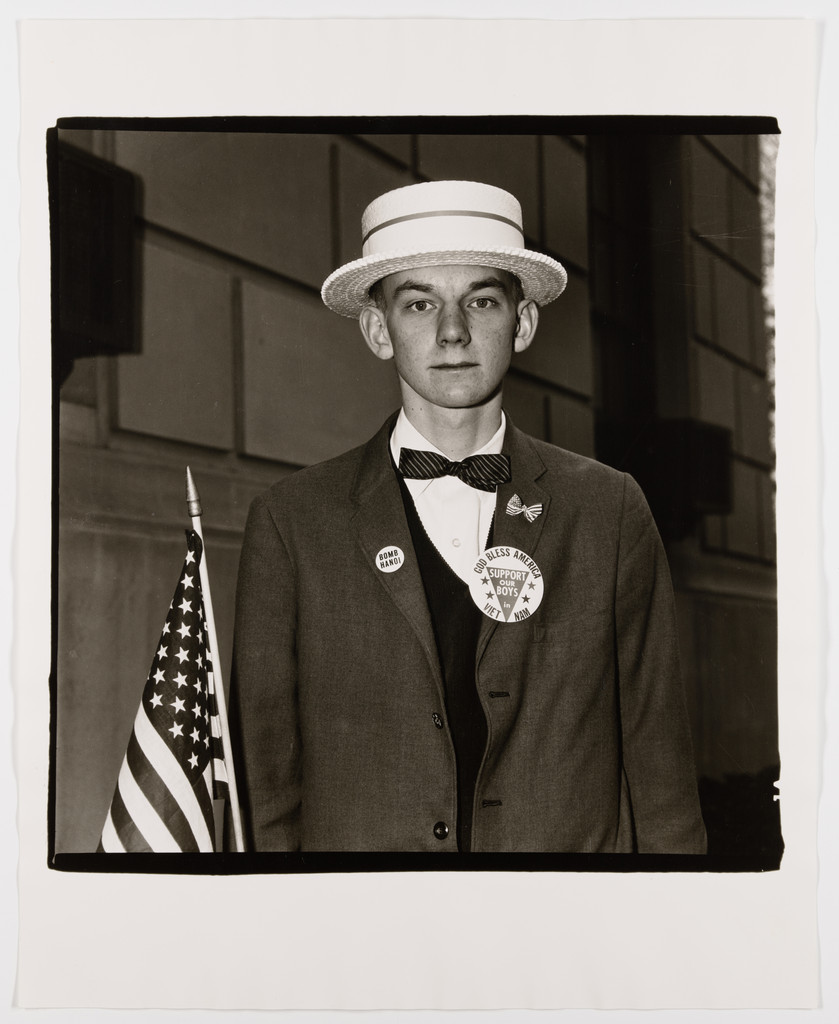
Look at his face. Not at the buttons — not yet. Just the face. He can't be more than seventeen. There's something in that gaze that Arbus found over and over: a person performing certainty, and the camera catching the thinnest seam where the performance doesn't quite hold.
He's dressed for it. The straw boater, the bow tie, the suit — all the costuming of a conviction inherited, not earned. In his left hand, a small American flag. On his lapel: BOMB HANOI. On his chest: GOD BLESS AMERICA / SUPPORT OUR BOYS IN VIET NAM.
This is 1967. Next year, Martin Luther King Jr. will be assassinated. Bobby Kennedy will be assassinated. The Democratic Convention in Chicago will erupt into violence on live television. Prague Spring will bloom and be crushed by Soviet tanks. Students will occupy universities from Columbia to the Sorbonne. The Tet Offensive will shatter any remaining illusion that the war is being won.
But right now, this boy is waiting. He hasn't marched yet. He's standing still, in front of Arbus's waist-level Rolleiflex, and something in that stillness is the whole story.
Arbus didn't photograph protesters. She photographed this boy — the one on the other side, the one who dressed up and showed up to say yes to a war that was already tearing the country apart. She found the uncanny not in the margins but in the mainstream. She looked at patriotism the way she looked at everything else: with a gaze that was intimate, unblinking, and entirely without judgment.
We begin here, one year before everything broke, because the breaking was already visible — if you knew how to look.