APRIL 11, 1968
Seven days after Dr. King's assassination
STOP 2 OF 8
While American cities burned, this photograph arrived from Vietnam.
"Wounded," April 11, 1968
Dana Stone / United Press International · Gelatin silver print
Look at the bandage. Torn cloth, improvised, wrapped around a head wound. One eye sealed shut. The other staring past the camera into some distance we can't see.
APRIL 4, 1968 — Martin Luther King Jr. assassinated in Memphis
APRIL 5–11 — Riots in 110+ American cities; 46 dead, 20,000+ arrested
APRIL 11 — This photograph transmitted by UPI wire service
Dana Stone was a wire-service photographer working in Vietnam. Not an artist. Not trying to make "a statement." Just trying to get the shot and get it on the wire before the competition did. The New York Times ran it. MoMA collected it.
This is what was arriving in 1968. Not just protest images from the streets of Chicago or Memphis. Not just concert posters and psychedelic graphics. This: wet cloth wrapped around a shattered eye socket. Mud. Exhaustion. The war, in the bodies of nineteen-year-olds, transmitted by satellite and wire, printed in newspapers across America every single morning.
The boy we just saw — the one with the straw hat and the BOMB HANOI button — he believed in this. Or his parents did. Someone did. Someone dressed him up and sent him to march.
Seven days before this photograph, Martin Luther King Jr. was shot on a motel balcony in Memphis. By April 11, over a hundred American cities had erupted. The National Guard occupied Detroit, Chicago, Baltimore, Washington D.C. Smoke was still rising.
And on the same day, this image — a soldier with a bandaged eye, waiting under a poncho for a medevac helicopter that may or may not come — landed on photo editors' desks across the country.
MoMA acquired this photograph as part of "The New York Times Collection" — not as art, but as evidence. A document of what was happening while the museum collected soup cans and color-field abstractions.
1968 didn't break all at once. It broke in a thousand places simultaneously. In Memphis and Saigon. In Paris and Prague. In a poncho-covered aid station and on a college campus. And all of it — all of it — was being photographed, transmitted, printed, and filed.
The question MoMA faced was simple: What do you collect when the world is on fire?
What strikes you most — the bandage, the stare, or the fact that this was just another day?
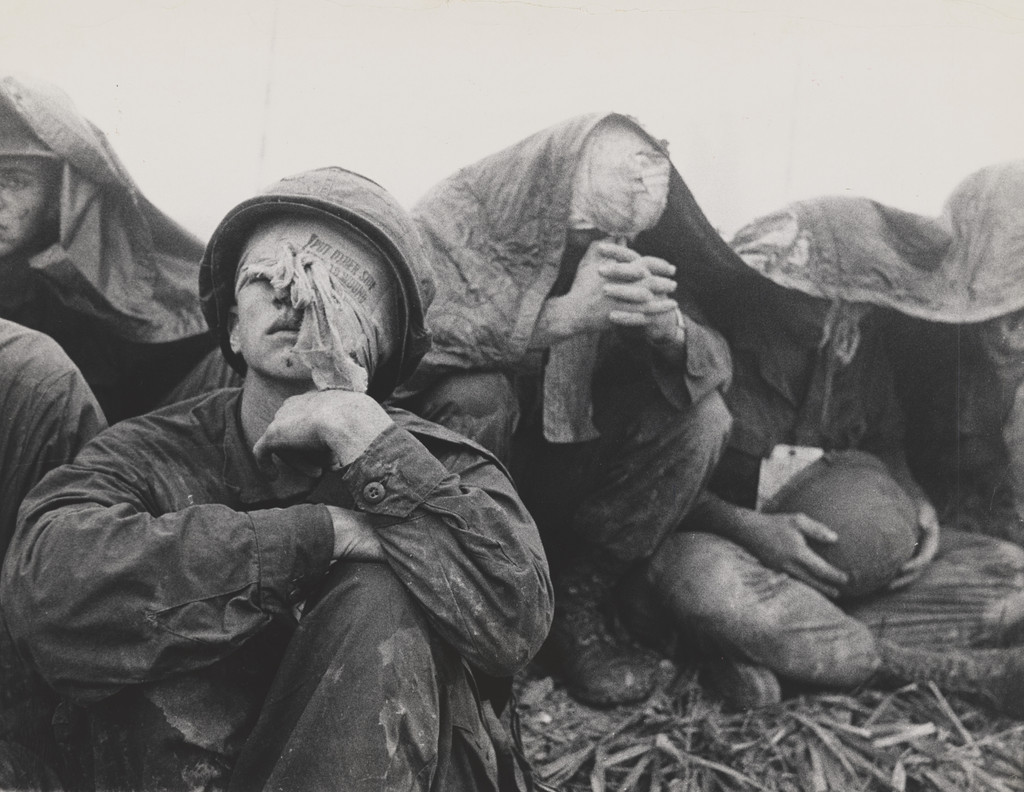
Look at the bandage. Torn cloth, improvised, wrapped around a head wound. One eye sealed shut. The other staring past the camera into some distance we can't see.
APRIL 5–11 — Riots in 110+ American cities; 46 dead, 20,000+ arrested
APRIL 11 — This photograph transmitted by UPI wire service
Dana Stone was a wire-service photographer working in Vietnam. Not an artist. Not trying to make "a statement." Just trying to get the shot and get it on the wire before the competition did. The New York Times ran it. MoMA collected it.
This is what was arriving in 1968. Not just protest images from the streets of Chicago or Memphis. Not just concert posters and psychedelic graphics. This: wet cloth wrapped around a shattered eye socket. Mud. Exhaustion. The war, in the bodies of nineteen-year-olds, transmitted by satellite and wire, printed in newspapers across America every single morning.
The boy we just saw — the one with the straw hat and the BOMB HANOI button — he believed in this. Or his parents did. Someone did. Someone dressed him up and sent him to march.
Seven days before this photograph, Martin Luther King Jr. was shot on a motel balcony in Memphis. By April 11, over a hundred American cities had erupted. The National Guard occupied Detroit, Chicago, Baltimore, Washington D.C. Smoke was still rising.
And on the same day, this image — a soldier with a bandaged eye, waiting under a poncho for a medevac helicopter that may or may not come — landed on photo editors' desks across the country.
1968 didn't break all at once. It broke in a thousand places simultaneously. In Memphis and Saigon. In Paris and Prague. In a poncho-covered aid station and on a college campus. And all of it — all of it — was being photographed, transmitted, printed, and filed.
The question MoMA faced was simple: What do you collect when the world is on fire?