Not instead of the war photographs. Not separate from them. Alongside them.
They were saying: this is America. The soup can and the war photograph are both true. Consumer culture and state violence. Comfort and catastrophe. All of it circulating in the same visual economy, all of it mediated by the same screens and pages and walls.
They were saying: we have no idea what to do with any of this. So we'll collect it all. We'll put it in the archive. We'll call it art and let future generations decide what it means that we looked at a soup can the same way we looked at a war.
Maybe both are true.
What's certain is this: in 1968, the museum didn't choose. It didn't say "we're a museum of beauty" or "we're a museum of politics" or "we're a museum of high culture." It said: we're a museum of looking. And in 1968, Americans were looking at everything — the war, the riots, the assassinations, the supermarket, the television, the gallery wall — all at once.
Warhol understood that. He made art that looked back.
Does it bother you that the soup can and the war photograph share the same walls?
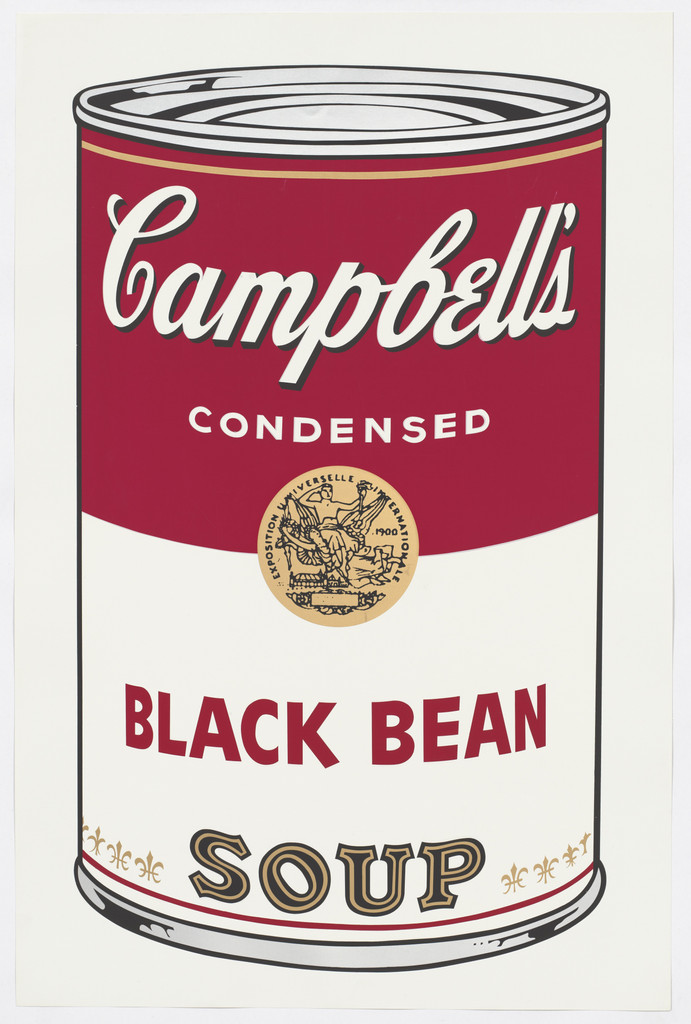
A soup can. Printed in a portfolio of ten. Black Bean, Chicken Noodle, Green Pea, Tomato. Sold through galleries. Hung on walls.
Warhol made his first Campbell's paintings in 1962. By 1968, he'd turned them into screenprints — mechanical, reproducible, identical. You could buy one. You could own a Warhol soup can and hang it in your living room while you watched Walter Cronkite report the body count from Vietnam on the evening news.
Andy Warhol (soup cans, Marilyn Monroe prints)
Dana Stone (wounded soldiers in Vietnam)
Don Hogan Charles (police violence at protests)
Diane Arbus (a boy at a pro-war parade)
All of them went into the collection. All of them were "art."
This is the scandal people forget about Pop Art. Not that it was vulgar or lowbrow or "not real art." The scandal was that it was cool. Smooth. Unbothered. It looked at America — at advertising, at consumer culture, at mass production, at fame, at violence, at death — and it turned it all into the same flat, silkscreened surface.
Warhol said that. He also said: "I think it would be terrific if everybody was alike." He made electric chairs and car crashes and race riots into prints, the same way he made soup cans and Marilyn Monroe into prints. Everything got the same treatment. Everything became image.
So when MoMA bought this soup can in 1968 — the same year they acquired photographs of bandaged soldiers and burning cities — what were they saying?