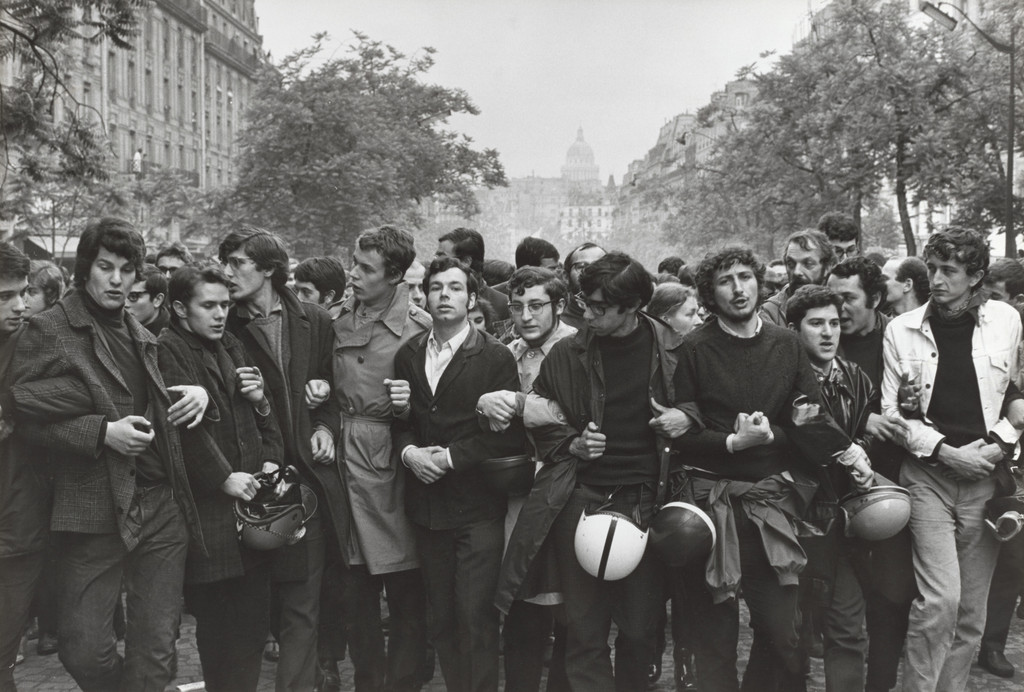
Two months after Columbia. Students occupying the Sorbonne. Workers occupying factories. Ten million people on strike. The government nearly falling. De Gaulle fleeing to Germany for a day, unsure if he still had an army.
If you'd been in Paris in June 1968, which side of the camera would you have been on?
Look at the composition. A horizontal band of linked bodies dividing the frame. Behind them: the grand Haussman architecture of Paris, the trees, the dome of the Panthéon rising in the distance like a monument to everything they're protesting against.
This is Henri Cartier-Bresson. He practically invented modern photojournalism. He photographed Gandhi hours before his assassination. He was the first Western photographer allowed into the USSR after Stalin's death. He coined the phrase "the decisive moment" — the idea that there's a single instant when form and content align perfectly.
And in June 1968, at sixty years old, he was on the streets of Paris photographing students half his age linking arms and marching toward the camera.
(Be realistic, demand the impossible.)
The photograph is almost classical in its composition. The line of figures creates a frieze, like a Greek temple carving. But the faces — look at the faces. They're not heroic. They're wary. Determined, yes, but also uncertain. They don't know if they're going to win. They don't even know, really, what winning would look like.
What they do know is that the same thing is happening everywhere. In New York and Prague and Mexico City and Tokyo. Students are occupying buildings. Workers are striking. The old order — Cold War politics, colonial wars, authoritarian universities, patriarchal culture — is being challenged all at once.
Cartier-Bresson gave this photograph to MoMA. Not sold it — gave it. Which means something. It means he wanted it in the archive. He wanted it to be part of the record of what photography could do: not just document history, but participate in it. Not just capture the decisive moment, but create it.
By June 1968, the pattern was clear. April in New York, May in Paris, August in Prague (Soviet tanks would crush that one), October in Mexico City (hundreds killed days before the Olympics). The photographs circulated. Students in one city saw what students in another city were doing and thought: We can do that too.
Photography didn't just record 1968. It transmitted it.
And museums like MoMA had to decide: Are we collecting art, or are we collecting evidence? Are we making aesthetic judgments, or are we building an archive of a world coming apart?
The answer, it turned out, was yes.