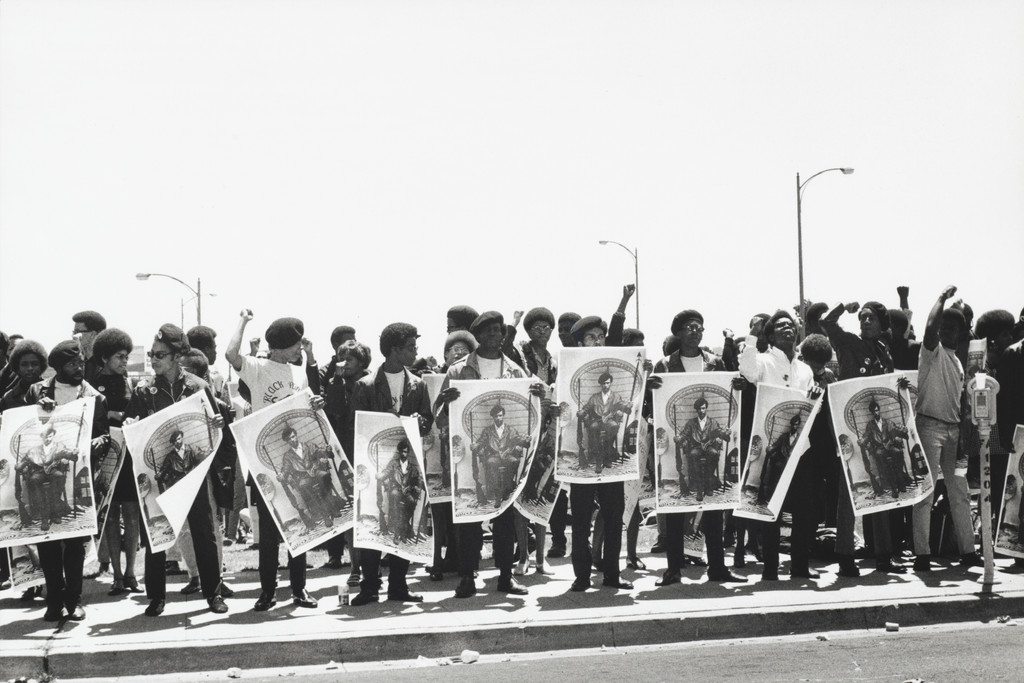
One month before Tommie Smith and John Carlos would raise their gloved fists on the Olympic podium in Mexico City, this was happening in Oakland.
When you see that image of Smith and Carlos on the podium — do you think of it as sports history, or something else?
Look at the posters. All identical. Huey P. Newton seated in a wicker chair, rifle in one hand, spear in the other, like a revolutionary pharaoh. FREE HUEY. Repeated down the line like a drumbeat.
Panthers rally daily at courthouse
Nationwide "Free Huey" campaign
OCTOBER 16, 1968 / MEXICO CITY: Tommie Smith (gold) and John Carlos (bronze) raise gloved fists during national anthem
Both wear Black Panther buttons
Both expelled from Olympics within 48 hours
Stephen Shames was twenty years old when he took this photograph. A college student. He'd started photographing the Black Panthers because he believed in what they were doing: free breakfast programs for kids, health clinics, armed patrols to monitor police. And yes, the guns. The uniforms. The rhetoric. The image.
Because that's what the Panthers understood: in 1968, the image was the message. You couldn't separate them. The black leather jackets, the berets, the raised fists, the poster of Huey in the chair — all of it was designed to circulate. To be photographed. To be seen.
One month later, Smith and Carlos would stand on that podium in Mexico City. They'd bow their heads. They'd raise their fists — one gloved in black, symbolic. The image would go out on the wire services instantly. Within hours, it would be on the front page of every newspaper in the world.
And the International Olympic Committee would expel them. Send them home. Try to erase what they'd done.
But you can't erase an image once it's been transmitted. That's the thing 1968 taught everyone. Columbia students climbing through a window — that image travels to Paris. Paris students linking arms — that image travels to Prague, to Tokyo, to Mexico City. Black Panthers marching in Oakland — that image travels to the Olympics. The Olympics protest — that image comes back to America and becomes a poster, a button, a symbol.
Photography in 1968 wasn't just documentation. It was coordination. It was how movements knew they were movements. How protests in one city inspired protests in another. How a gesture — a raised fist, a linked arm, a sign reading JOIN US — became a vocabulary everyone could speak.
MoMA was collecting all of it. The wire-service photographs. The protest posters. The silkscreened soup cans. The fashion photography. The documentary work. All of it going into the same archive, the same collection, the same museum.
Because in 1968, it was all connected. The art world and the street. The gallery and the courthouse. The Olympics and the revolution.
The raised fist in Oakland and the raised fist in Mexico City weren't different gestures. They were the same gesture, transmitted through the same networks, meaning the same thing: We see you. We're here. We're not going away.