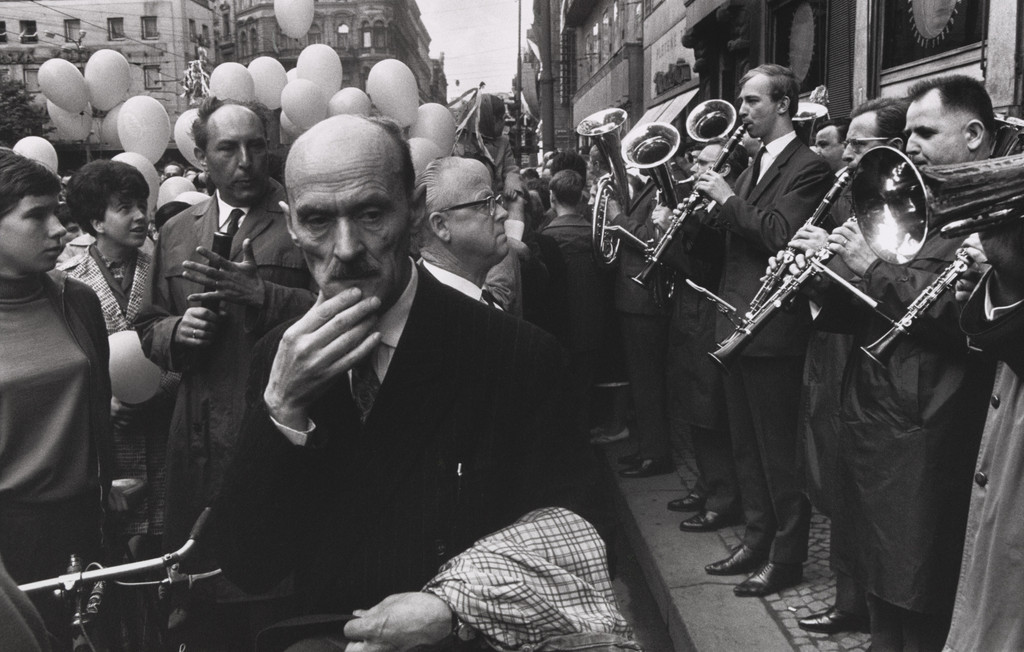
August 1968. Soviet troops invade Czechoslovakia to crush the Prague Spring. Josef Koudelka is there with his camera. This photograph was taken before the invasion — in the spring, during the brief moment when it seemed possible that socialism might have a human face.
What do you think this man was thinking about?
Look at his face. Behind him, balloons. A brass band. A parade. People celebrating. And him — hand to mouth, eyes down, entirely alone in a crowd.
This photograph is from before the invasion. Spring or early summer. A parade, probably official — maybe a workers' celebration, maybe a state holiday. The kind of orchestrated public joy the Communist Party specialized in.
And this man knows. He knows what's coming. Or maybe he just knows what isn't coming — the freedom they were promised, the reforms, the "socialism with a human face." He knows the celebration is hollow.
Koudelka spent the week of the invasion on the streets of Prague. He shot hundreds of photographs. Tanks. Protesters. Burning buildings. Bodies. He smuggled the negatives out of the country. They were published worldwide, anonymously, attributed only to "P.P." — Prague Photographer. He couldn't take credit. If the regime knew it was him, they'd arrest him. Or worse.
By the time MoMA acquired this photograph, Koudelka was in exile. He'd left Czechoslovakia in 1970, knowing he could never go back. The regime lasted another nineteen years. He didn't see Prague again until 1990.
This is what happened in 1968. Everywhere, briefly, it seemed like the old order might crack open. Students occupied buildings. Workers went on strike. Artists made revolutionary posters. Czechoslovakia tried to reform from within. For a few months — April in New York, May in Paris, spring in Prague — it felt possible.
And then the old order reasserted itself. Police stormed Columbia. De Gaulle called elections and won. Soviet tanks rolled into Prague. In Mexico City, ten days before the Olympics opened, government forces massacred hundreds of student protesters in Tlatelolco Square.
By the end of 1968, most of the uprisings had been crushed. Most of the protesters had gone home. Most of the leaders were in jail or in exile.
But the photographs remained. Cartier-Bresson's Paris demonstrators. Schapiro's Columbia window. Shames's Black Panthers. Koudelka's Prague. All of them in the archive now. All of them evidence that 1968 happened. That people tried. That the breaking was real, even if the breakthrough didn't come.
MoMA didn't stop collecting when the year ended. The photographs kept arriving. The evidence kept piling up. Not art for art's sake. Not beauty for its own sake. Just the record. The witness. The proof that someone was there with a camera when the world tried to change and failed and changed anyway.