After everything — the protests, the assassinations, the riots, the occupations, the tanks — Americans built a rocket and left Earth entirely.
Thank you for walking through 1968 with me. Thank you for looking.
These eight stops are just fragments. There are hundreds more photographs, prints, posters, and objects from 1968 in MoMA's collection. Thousands more in museums around the world. Millions more in archives and attics and old newspapers.
The question the museum asked itself in 1968 was: What do we collect when the world is on fire?
The answer turned out to be: Everything. We collect everything. We bear witness to all of it.
Because fifty years later, a hundred years later, someone will want to know: What did it look like? What did it feel like? What were people seeing when the world broke open?
And the photographs will still be here. Waiting.
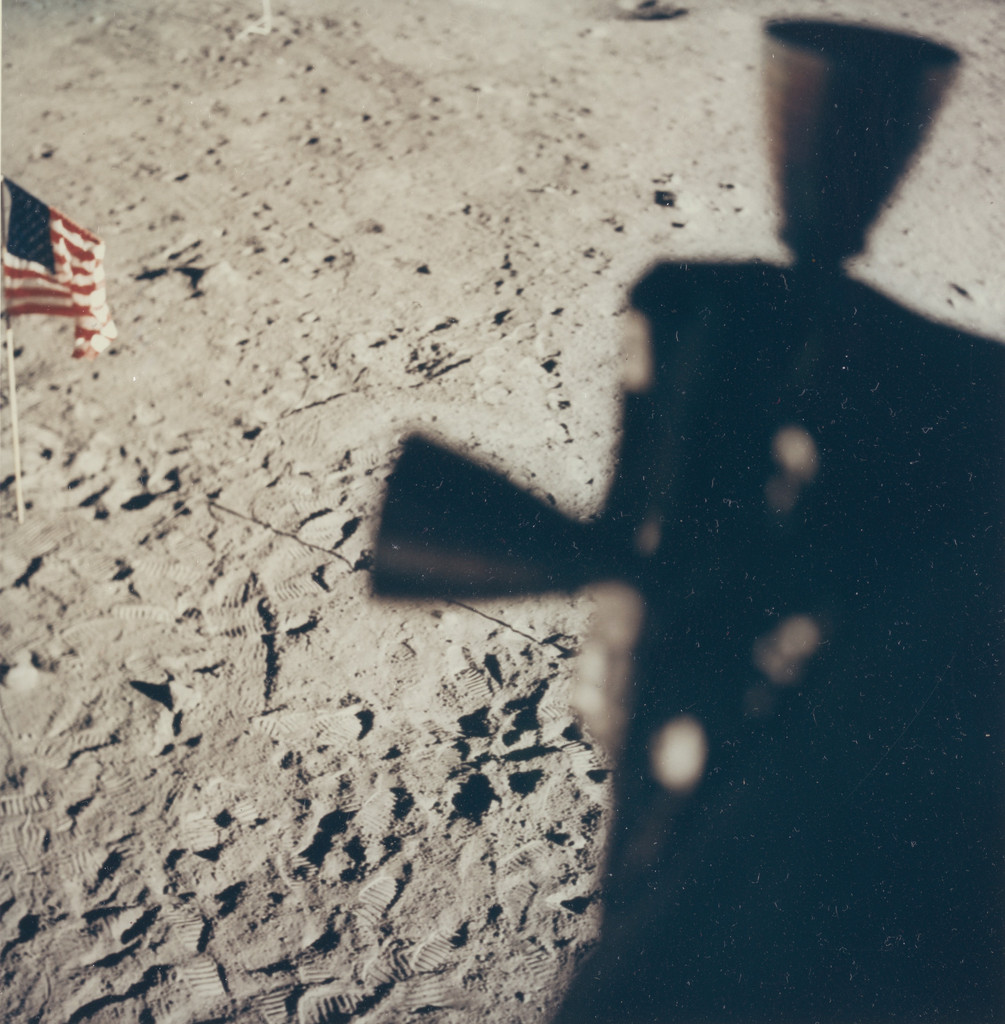
The shadow of an astronaut. The American flag. The moon.
This photograph was taken on July 20, 1969, seven months after 1968 ended. By then, Richard Nixon was president. The war in Vietnam would continue for six more years. The student movements had largely dispersed. The Panthers were being systematically targeted by the FBI. Koudelka was in exile.
But on this day, two men were walking on the moon. And they brought a camera.
And yet: there they were. Standing on a dead rock 240,000 miles from home. Looking back at Earth — that fragile blue marble hanging in the void, every war and protest and murder and hope contained in a sphere you could cover with your thumb.
— William Anders, Apollo 8
MoMA collected this photograph too. Right alongside the war photography and the soup cans and the student protests. NASA's images went into the same archive as Koudelka's Prague and Schapiro's Columbia and Cartier-Bresson's Paris.
Because that's what photography does. It doesn't choose between the moon landing and the street protest. It doesn't separate "history" from "art." It just collects. It witnesses. It preserves. It transmits.
The year 1968 broke because everyone was looking. Looking through viewfinders. Looking at television screens. Looking at newspapers. Looking at photographs traveling on wire services from Saigon to Prague to Oakland to Paris to Mexico City to the moon.
And museums — even museums that started out collecting paintings and sculptures for their beauty — had to reckon with that. Had to decide: Are we going to pretend this isn't happening? Or are we going to collect the evidence?
MoMA chose to collect the evidence.
Not because soup cans and moon landings and protest photographs were "equally important" in some abstract sense. But because they were all actually happening. All being seen. All being transmitted through the same visual networks. All changing how people understood the world they were living in.
1968 was the year everything broke. But it was also the year photography proved it could hold more than beauty. It could hold witness. It could hold grief. It could hold revolution. It could hold the moon. It could hold the view from 240,000 miles away, looking back at a planet tearing itself apart.
And museums could hold all of it. The soup can and the soldier. The parade and the protest. The raised fist and the flag on the moon.
All of it, in the archive. All of it, evidence that 1968 happened.