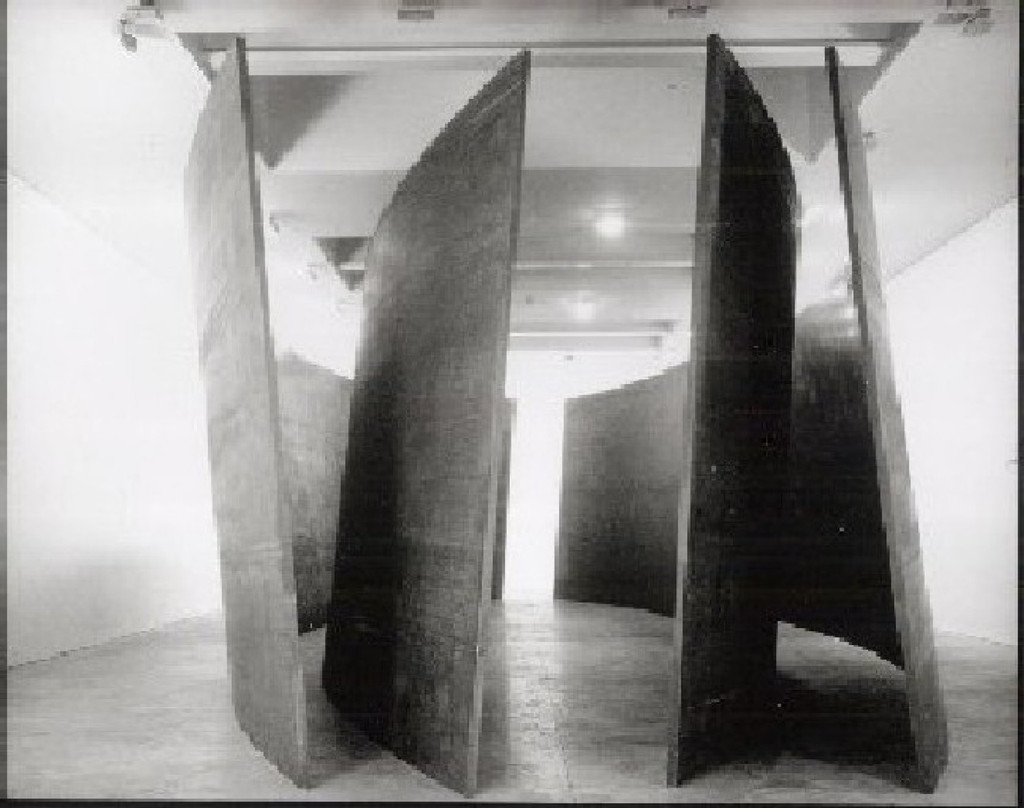
Stop 01
Intersection II
Richard Serra · 1992–93 · Weatherproof steel, four conical sections
Think about the last time a space changed how you felt in your body — a cathedral, a narrow alley, a room with very high ceilings. What was it? What did it do to you?
Before you read a word about this sculpture, your body already knows something. It knows the steel is taller than you are. It knows the passages between those curved walls are narrow enough to change how you breathe. It knows that 80,000 pounds of weatherproof steel, bent into curves that nearly touch the ceiling, is not asking for your opinion. It is asking for your presence.
Richard Serra spent six decades making work that could not be photographed, only walked. Intersection II is four identical conical sections — each over thirteen feet tall and fifty feet along the curve — arranged so that the gaps between them become the sculpture as much as the steel itself. You don't look at it. You move through it. The walls lean and tilt around you. Your peripheral vision fills with rust-dark metal. The floor beneath you feels different.
That's taller than most rooms you've ever stood in.
That's thinner than your thumb.
This is what Serra meant when he said sculpture should be about "the body moving through space." Not the eye scanning a surface from across the room. Not a thing on a pedestal. An experience you can only have by being there, in your specific body, at your specific height, taking your specific steps between those walls that curve away from you and toward you at the same time.
The photograph you're seeing flattens all of this into an image. But even flattened, something comes through — the way the steel seems to breathe open at the center, the way the light falls differently on each curved face, the way you can feel the weight even through a screen. That feeling is where this tour begins.