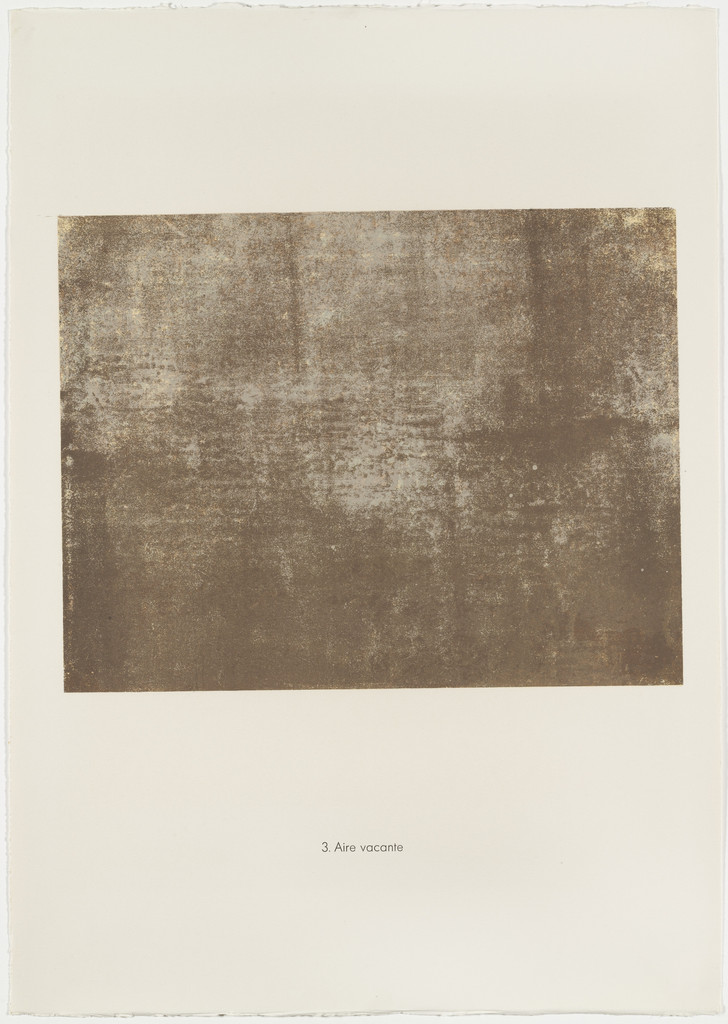
Vacant Space
(Aire vacante)
from the portfolio Anarchitect
You've moved from monumental steel to intimate drawings to pure texture.
Now: emptiness.
Not the absence of something.
The presence of nothing.
Think about the empty spaces you navigate every day.
Name an empty space you've stood in recently — one that made you aware of how much room there was around you.
This is Dubuffet again — the same artist who gave you texture in the last room — but now he's given you what remains when texture is all there is. Aire vacante. Vacant air. A lot where a building used to be. A wall with nothing on it. The space between things.
that refuses to build, that celebrates
the eroded, the leftover, the overlooked.
Look at what he's done: printed a rectangle of brown-gray tone, mottled and weathered like concrete left in the rain for years. No figures. No horizon. No composition in the traditional sense. Just a field. A patch of nothing. The kind of space you walk past every day without noticing — a stretch of sidewalk, a parking lot, an alley wall.
But the paradox is that this emptiness is full. Full of subtle shifts in tone. Full of texture you want to touch. Full of time — you can feel the years in those stains and scuffs. Dubuffet called this portfolio Anarchitect because it's anti-architecture: instead of designing buildings, he's documenting the spaces buildings leave behind.
After the tactile density of the last print, this one asks you to rest your eyes on blankness. To notice that vacancy has its own presence. That the wall you're not looking at — the one behind you, the one across the room — is still there, still taking up space, still shaping how you move.
Your body knows about vacant space. You sense it when you walk into an empty room. You feel it when you stand too close to a stranger. You measure it constantly without thinking: the gap between your hand and the door, the distance from your body to the wall.