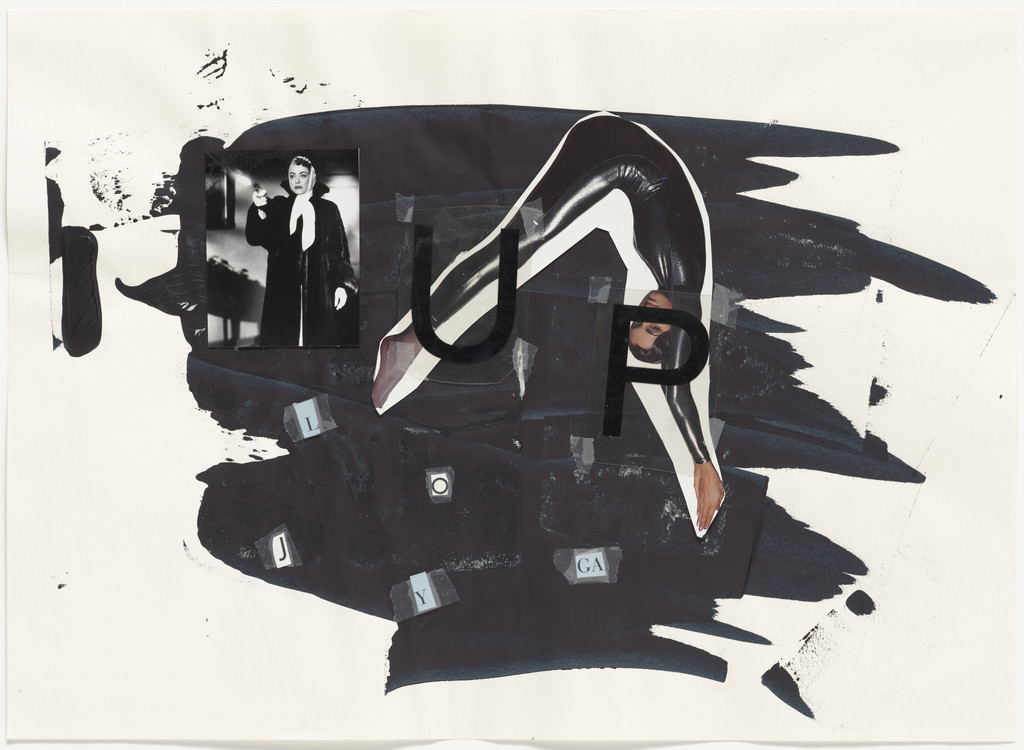
Body Movement Alphabet Study
Sheet: 16 7/16 × 22 11/16 inches (41.7 × 57.6 cm)
After emptiness,
the body returns as alphabet.
What if every letter was a posture?
What if language lived in your spine?
Stand up. Choose a letter below. Try to make its shape with your arms, your torso, the angle of your legs. Feel what it takes.
If your body could only make one shape for the rest of your life — one letter, one gesture — what would it be?
In 1926, Czech designer Karel Teige published a book called ABECEDA — an alphabet made entirely of bodies. A dancer named Milča Mayerová twisted herself into the shape of each letter while a photographer captured her contortions. Nearly eighty years later, Polish artist Paulina Olowska found that book and decided to revive it.
with three dancers contorting into all 26 letters.
In 2012, she did it again at MoMA.
And in between, she made these collages — studies for an alphabet
that would turn language into something you feel in your muscles.
Look at what's happening in this collage: layered fragments of vintage photographs, bold strokes of black paint like gestural brush marks, a white outline that might be an arm or a torso arching backward. The body becomes geometry. Movement becomes letter. You can almost feel the effort — the reach, the twist, the precarious balance required to hold the shape of an A or a Q or whatever letter this fragment represents.
Olowska works by reanimating forgotten histories. She salvages images from Polish fashion magazines of the 1960s and '70s, from Art Deco interiors, from modernist experiments that were interrupted by war or politics or time. "It is always somehow sweeter," she once said, "to work with a friend or a ghost."
This collage is working with a ghost: Teige's original ABECEDA, a utopian project from a moment when artists believed you could redesign everything — not just furniture and buildings, but the very shapes of communication. What would it mean to learn the alphabet not by tracing letters on paper, but by becoming them? By bending your body into unfamiliar forms until language lived in your spine?
After four stops that asked you to notice walls, hands, textures, and empty spaces, this one asks: what if your body is the message? What if every gesture you make is a letter you're writing in the air?