For twenty-two minutes, Vito Acconci films his own face in extreme close-up. His hands enter the frame — you can see a turquoise ring on one finger — and touch his face. Not gently. They press into the skin. They cover his mouth. They push at his cheeks and forehead as if testing how much the face can be deformed before it stops being a face.
This is the distance of intimacy. The distance of a lover's face on the pillow next to yours. The distance a parent is from a child's face when checking for fever. The distance a doctor is when examining your eyes. It's a distance reserved for people who have permission to be this close.
Acconci gives you no permission.
He puts his face this close to yours anyway.
The video doesn't care if you're comfortable.
What makes this work so uncomfortable isn't just the closeness — it's that Acconci is touching himself while you watch. The hands belong to the same person as the face. He's performing intimacy alone, for the camera, which means he's performing it for you. You become complicit. You're the reason he's doing this.
In 1974, video art was still new enough that this kind of work felt genuinely transgressive. Acconci was one of a generation of artists — along with Joan Jonas, Bruce Nauman, Martha Rosler — who used the camera not to document performance but to create it. The camera wasn't a witness. It was a participant. And so were you.
After seven stops that asked you to notice walls, measure distances, read textures, and watch shadows, this one abolishes distance entirely. You are here. In the same frame as another human body. Close enough to see pores and stubble and the moisture on lips. Close enough to feel implicated.
The title — Face of the Earth — suggests something vast and geological. But what you're actually seeing is a face as terrain. Skin as landscape. The body at a scale where it stops being a person and becomes a field you could map.
The Grammar of Distance
Public distance: 12+ feet
The space for lectures, performances, strangers on the street
Social distance: 4–12 feet
The space for conversations, meetings, casual interactions
Personal distance: 1.5–4 feet
The space for friends, the edge of comfort with acquaintances
Intimate distance: 0–18 inches
The space for lovers, parents, children · where this video lives · where you are right now
How close is too close? When does proximity become intrusion?
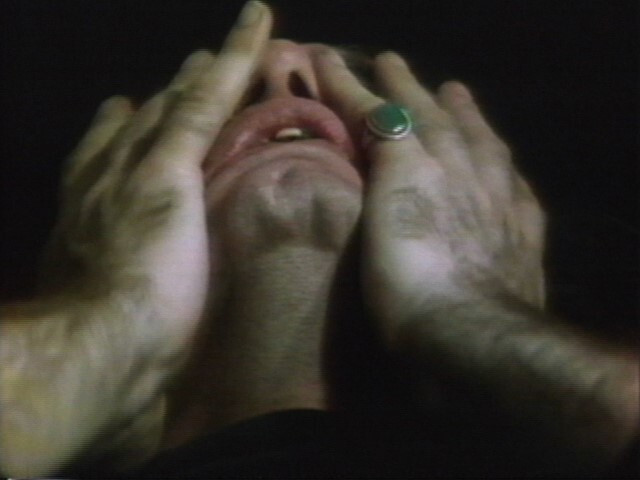
For twenty-two minutes, Vito Acconci films his own face in extreme close-up. His hands enter the frame — you can see a turquoise ring on one finger — and touch his face. Not gently. They press into the skin. They cover his mouth. They push at his cheeks and forehead as if testing how much the face can be deformed before it stops being a face.
This is the distance of intimacy. The distance of a lover's face on the pillow next to yours. The distance a parent is from a child's face when checking for fever. The distance a doctor is when examining your eyes. It's a distance reserved for people who have permission to be this close.
He puts his face this close to yours anyway.
The video doesn't care if you're comfortable.
What makes this work so uncomfortable isn't just the closeness — it's that Acconci is touching himself while you watch. The hands belong to the same person as the face. He's performing intimacy alone, for the camera, which means he's performing it for you. You become complicit. You're the reason he's doing this.
In 1974, video art was still new enough that this kind of work felt genuinely transgressive. Acconci was one of a generation of artists — along with Joan Jonas, Bruce Nauman, Martha Rosler — who used the camera not to document performance but to create it. The camera wasn't a witness. It was a participant. And so were you.
After seven stops that asked you to notice walls, measure distances, read textures, and watch shadows, this one abolishes distance entirely. You are here. In the same frame as another human body. Close enough to see pores and stubble and the moisture on lips. Close enough to feel implicated.
The title — Face of the Earth — suggests something vast and geological. But what you're actually seeing is a face as terrain. Skin as landscape. The body at a scale where it stops being a person and becomes a field you could map.