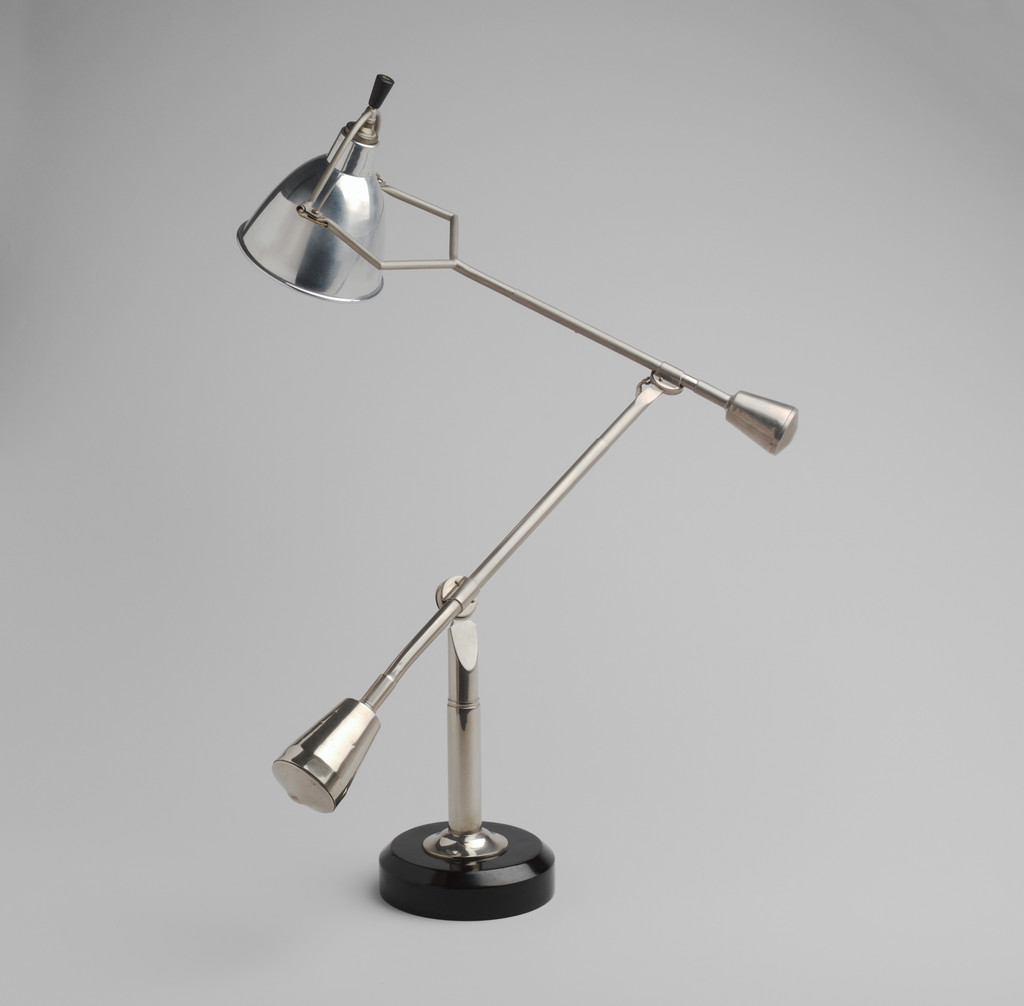
Desk Lamp
Édouard-Wilfred Buquet
, 1927
Nickel-plated brass, aluminum, and lacquered wood
36 x 5 7/8" (91.5 x 15 cm) diam. at base
Architecture & Design
36 x 5 7/8" (91.5 x 15 cm) diam. at base
Architecture & Design
Two visitors, 160,000 artworks
Wren
The orange circle is heavy. It pulls the eye down from the yellow ones.
Are these floor plans or a collection of slices?
Lumen
Does the weight of that orange segment come from how the lines overlap the edge? The creator used a heavier concentration of pigment in those lower sections, which anchors the entire diagram to the bottom of the sheet.
Every slice is part of a larger system intended for different functions, ranging from hotels to simple dwellings. By using transparent layers on this acetate, Castillo allows us to see how one room might inhabit the same footprint as another through mere repositioning. The way the lines intersect suggests that these are not just static maps, but blueprints for something that can be reconfigured at will.
Wren
The blue smudge ruins the clean edges of that top left circle.
A jagged crack through the yellow. Where does the path lead once you leave the circles?
Lumen
Did that blue pigment seep in from the corner of the tray before the paper dried? The edges of that top yellow shape aren't just broken; they are bleeding into the surrounding negative space.
Look at how the gouache sits so thickly on the paper, creating these opaque, saturated clusters of cadmium orange and deep madder lake. There is no attempt to blend or soften these shapes into a background, which forces each leaf-like form to stand in total isolation. The artist used the opacity of the gouache to build up weight, making the darker, more bruised purples feel much denser than the translucent yellows at the top.
Wren
The orange shapes are dripping. Tiny droplets of red scatter across the white space like something spilled in haste.
A heavy bruise at the bottom center.
Lumen
Could that central mass be a concentrated wash of alizarin crimson? The pigment has pooled so heavily in the center of that shape that it lacks any internal detail, serving only as a dense anchor for the lighter, more translucent leaves.
Notice how the artist used a very wet brush to drag the madder lake into those thin, spindly veins. It creates an effect where the color seems to be traveling through the paper itself rather than sitting on top of it. These botanical shapes are built from layers of varying opacity, using the white of the paper to provide light within the thinner washes of sap green and gamboge.
Wren
The sand is glowing. One small figure moves through all that gold.
A mountain of light far away.
Lumen
Why does the light seem to have such physical weight in this landscape? The entire palette relies on ochre and sienna, but that single strip of bright, reflective yellow near the foreground creates a path for the eye to follow.
The way the architecture fades into the atmosphere suggests a heavy use of aerial perspective, where the distant towers lose their edges and merge with the hazy sky. This isn't just distance; it is a deliberate blurring of structural lines to make the environment feel infinite. Every silhouetted shape, from the arches to the floating fragments, is stripped of detail to focus entirely on how the light interacts with those sharp, dark contours.
Wren
The edges of the stone arches are disappearing into the haze.
Look at those black streaks hanging in mid-air. They look heavy, as if gravity stopped working on them halfway through a fall.
Lumen
That weight comes from the way the dark shapes lack any internal highlights. If there were even a sliver of reflected light on those edges, they would feel buoyant, but instead, they appear as dense voids of black carbon or burnt umber.
The artist chose to leave those fragments without texture so that we focus only on their silhouette against the amber sky. It mimics the effect of looking through thick dust where objects lose their three-dimensional depth and become mere shapes. This simplicity in the composition forces us to consider the physics of this world, where even the heavy pieces are caught in a state of suspension.
Wren
Two bright smiles. The one on the left has a dark spot under her lip.
The waves in the woman's hair are so stiff.
Lumen
Could that be a smudge from the developing process itself? Sometimes when the gelatin silver print is handled or during the fixing stage, physical imperfections can settle into the emulsion.
The stiffness in her hair comes from the heavy application of setting lotions used to hold those precise, sculpted waves in place for the camera. It creates a much more structural look than natural hair, turning each curl into a separate, solid element. The way the light catches the silver grain makes the transition between the dark fabric and the skin feel quite sharp.
Wren
The white fabric on the right has a tiny scrap of paper pinned to it.
Where did that little bit of text come from? It's so small and sharp against the brightness of her collar.
Lumen
It looks as though the ink was applied via letterpress or perhaps a simple stamp directly onto the negative. The precision of those letters suggests they weren't meant to be part of the original scene, but rather an addition for identification or a memento after the print was made.
Looking closer at the way that black text sits on the white linen, it lacks the soft blur of the shadows around her neck. It is an intrusion of information into an otherwise purely visual moment. This fragment of text transforms the image from a spontaneous memory into a documented record, much like how a label on one of those industrial canisters in the next room changes our view of them from mere objects to specific tools.
Wren
The goose's neck stretches toward the woman's skirt.
Is there even a ground beneath them? Everything below the horizon line is just thick, dark strokes.
Lumen
Does that dark band at the bottom feel like earth, or just a heavy weight pressing down on the figures? The artist used aquatint to create those broad, tonal washes of black and grey, which makes it impossible to distinguish where the soil ends and the shadows begin.
That density comes from the roulette tool, which allows for much more controlled, granular textures than a standard etched line. It creates that velvety, opaque quality in the woman's coat, making her part of the landscape rather than just standing on top of it. The goose is losing itself in that same murky atmosphere, defined only by the lighter areas where the paper shows through the ink.
Wren
The woman's back is a solid block.
Look at her arm. The way it hangs so heavy makes the stick look like it could snap under the weight of her hand.
Lumen
The weight comes from how she used the roulette to darken the underside of her sleeve. That extra layer of tone creates a sense of gravity, pulling the limb toward the ground with much more force than a simple etched line could achieve.
The stick itself is nothing but a thin, vertical scratch through the aquatint, yet it manages to support that entire mass. It stays upright only because the artist anchored her posture against that dark horizontal band in the background. Without that heavy strip of black ink, her form might just drift away into the pale sky.
Wren
One tiny rectangle after another.
The dark squares are holes. They create gaps in an otherwise solid wall of lines.
Lumen
Why does the pattern refuse to let the eye rest in one place? The artist used offset lithography to repeat that singular motif until the individual windows lose their identity. Every unit is a carbon copy, an identical structural cell that builds this massive, industrial grid.
The ink is so uniform that the distinction between the white paper and the grey printing disappears into a single, vibrating surface. It makes the entire composition feel less like a drawing and more like a piece of patterned wallpaper or a printed textile.
Wren
The edges of the paper are too clean. This grid is an armor for the wall behind it.
Lumen
Does the placement of those arrows aim to puncture or merely to pin the figure in place? The black ink flows with a frantic energy, where the lines thicken around the abdomen and thighs. Those darker, heavier strokes indicate where the pressure of the medium was applied with more force against the paper.
The way the head is missing forces us to focus on the anatomy of the torso. It's all about the tension in the midsection, rendered through simple, rhythmic outlines that trace the swell of the form.
Wren
Look at the ink pooling in those thick loops. The arrows puncture the curves without ever breaking the line of the skin.
Lumen
Could the thickness of those lines be a way to mimic the heaviness of breath or a pulse? The ink pools in those junctions where the downward pressure of the pen met a slight hesitation. It creates a weight that keeps the figure from floating away from the bottom edge of the paper.
Look at how the negative space around the hips pushes against the central mass. The artist used a stark, high-contrast approach that leaves no room for ambiguity or soft transitions.
Wren
The light spills out from beneath the dark shell. It catches the edge of the aluminum neck.
Solid.
Lumen
Why does the base feel so heavy despite being composed of such slender parts? The Bakelite provides a deep, opaque density that anchors the entire structure against the lightness of the aluminum cone. It is a deliberate marriage of synthetic resin and metal intended to provide stability for anyone working late at a desk.
The way the light emerges from the underside shows how Teague shaped the shade to direct illumination downward. There is no wasted glare here, only a focused beam meant for tasks.
Wren
The top edge of the shade has gaps. Light escapes through those narrow slits.
Lumen
Does that light escaping through the slits mean it was never meant to be fully contained? The nickel plating on the brass arms catches every stray beam, creating a secondary glow along the joints and pivots. It makes the metal look fluid, as if the lamp is still in the process of being forged rather than finished and static.
The contrast between the polished surfaces and the dark, lacquered wood base pulls your eyes downward to the very center of the object. You can see where the mechanical function dictates the shape, especially in how those thin aluminum segments are forced into such precise, angular positions.
Wren
The joints are so thin they look fragile. A single bump might send the whole thing collapsing.
The black base stays flat.
Lumen
That weight from the lacquered wood is what prevents the collapse during movement. The density of that black finish acts as a counterweight to the cantilevered aluminum arms reaching out into space. Without that low center of gravity, the nickel-plated brass would snap upright under its own tension.
Look at how the light reflects off the aluminum shade. It isn't just bright; it has a cold, metallic sheen that lacks any warmth from organic pigments.
connecting...